Google Play now carries its rivals — and still owns every download
/ A US court forced Google to let rival app stores into Play and share its catalog with them. It went live on July 22. But tap install in Epic's store and Google Play still does the download, the scan, and the billing — for $5,000 a year plus its usual cut.
by Hozefa Khety
· 9 min read
On July 22, the Google Play Store started carrying its own competitors. US Android users can now install rival app stores — Epic's, Amazon's, and any other storefront that clears Google's review — directly from Play, the same way they would install any other app. No APK files, no unknown-sources warning, no sideloading detour. It is the first time a US court has forced an app store to distribute the stores trying to replace it.
That is a genuinely large change, and it is worth saying so plainly before the caveats arrive. But the caveats are the story. Because when you tap install inside one of those rival stores, the app you get is still downloaded by Google Play, still scanned by Google Play Protect, and still carries Google's service fee. The storefront changed. The plumbing did not.
What actually changed on July 22
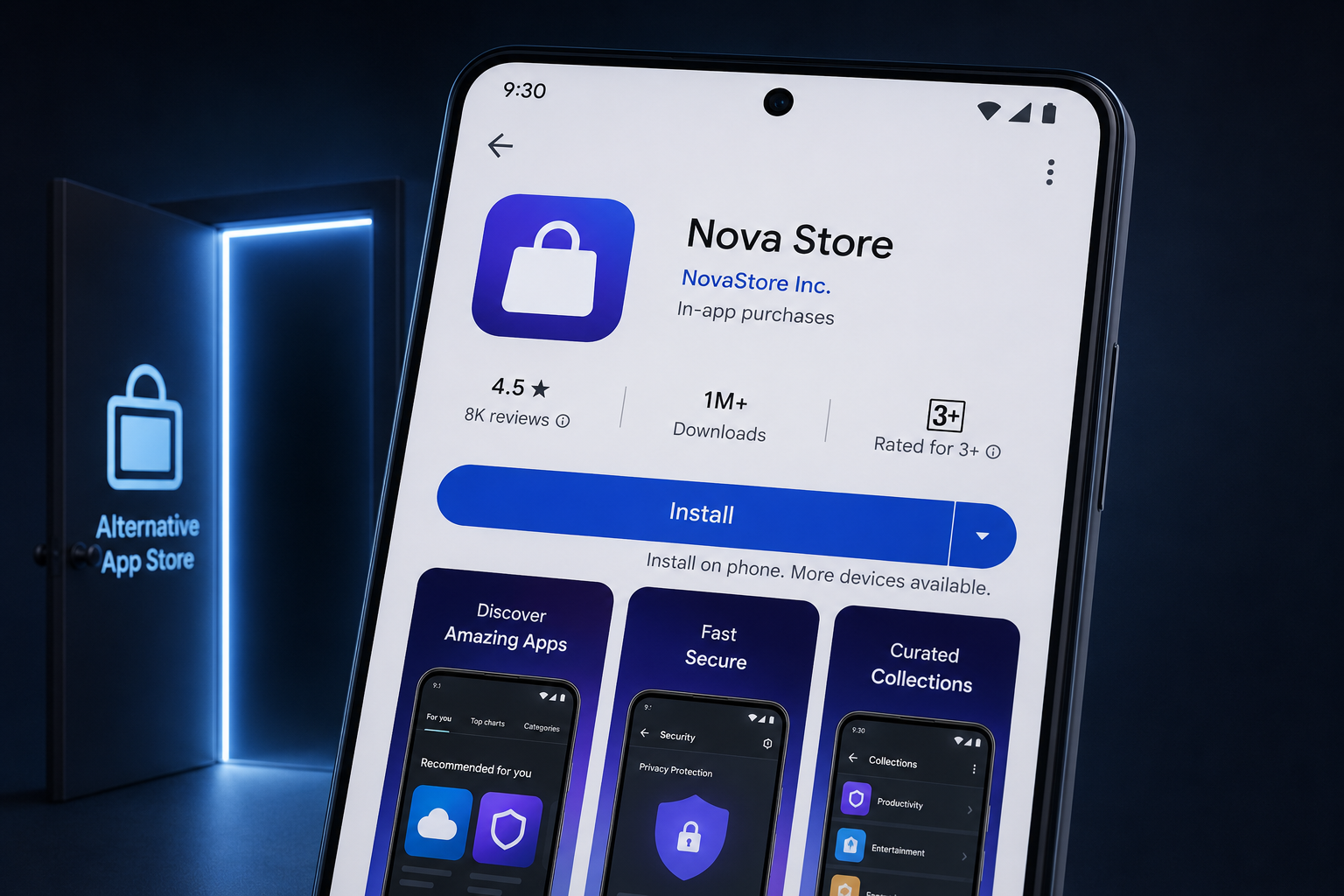
Two things went live at once, and it helps to keep them separate. The first is distribution: rival app stores can be listed in, and installed from, Google Play. The second is catalog access — the part with the formal name. Under the Play Catalog Access Program, an enrolled third-party store in the US can offer the apps that live in Google Play's catalog, rather than only the apps its own developers uploaded to it.
That second piece is what makes the first piece meaningful. A rival store nobody can find is a curiosity; a rival store nobody stocks is a ghost town. Historically the Epic Games Store on Android had Fortnite and a rotating handful of exclusives. Under catalog access, it can offer the apps people actually open every day — because it is drawing from Google's shelves.
Enrolment is not automatic and it is not free. A store has to submit a declaration form, pass a multi-step onboarding review covering safety and legal compliance, operate as a genuine open marketplace, and keep Play Catalog apps inside the United States. Google reviews each applicant. So the accurate way to describe the current state of play is not that six new stores appeared on your phone this week — it is that the door is now open to stores willing to walk through it.
The catch: Google still owns the checkout
Here is the sequence when you install a Play Catalog app from a rival store. You tap install in, say, Epic's storefront. That store fires an Android intent through Google's new Inline Install API. Google Play takes over. Play Protect scans the app. Google Play completes the download and puts it on your phone. Then Google's Play service fee applies to what happens inside that app afterwards, exactly as it would have if you had never left Play in the first place.
Google's own documentation is direct about this: downloads of Play Catalog apps complete through Google Play on the same terms as a direct Play install, and Google's service fees continue to apply. Rival stores are additionally barred from adding their own download or install charge on top. The competitor is the shop window. Google Play is still the till, the stockroom and the security guard.
There is a reasonable defence of this design, and it is worth stating fairly: it means a user who installs a sketchy storefront does not thereby lose Play Protect scanning, and developers do not have to trust an unknown marketplace with their binaries. Safety is a real argument, not just a pretext. But it also means Google keeps the metering point. Every install through the front door of a competitor still walks past Google's counter — and Google decides what that costs.
If you build apps, you are already in this
The default matters here more than anything else in the announcement. From July 22, US developers' app and game listings became automatically available to eligible third-party stores through the Play Catalog — unless the developer opts out. Nobody had to sign up. Distribution widened by default, and the burden of saying no landed on the developer.
For most developers that is probably fine, or actively good: more shelves, same fee, same install pipeline, no extra build to maintain. But if you have contractual, licensing, or regional reasons to control exactly which storefronts list your app, this is a setting you want to have looked at deliberately rather than discovered later. The opt-out lives in Play Console. Inclusion is the default; declining is the deliberate act.
What it costs
For a store, access is metered: $5,000 up front to cover Google's security and policy review, and $5,000 a year to keep the access alive. That is trivial for Amazon or Microsoft and non-trivial for a small independent marketplace — which, depending on your view, is either a sensible filter against bad actors or a modest toll that shapes who gets to compete.
For developers, the familiar Play economics carry over unchanged. Since June 30, 2026, Google's service fee has been 20% on in-app purchases for new installs and 10% on recurring subscriptions and on a developer's first $1 million of annual revenue, with a reduced 15% new-install rate for participants in the Apps Experience and Games Level Up programmes. A separate 5% billing fee applies in the US, UK and EEA, and drops away if you route payments outside Google's billing system.
Note what that adds up to. The court forced open the storefront layer. It did not reset the rate card. A developer distributing through Epic's store under Play Catalog Access pays Google what a developer distributing through Play pays Google.
How it got here: six years of Epic v. Google
Epic sued Google in 2020, arguing that the Play Store was an illegal monopoly propped up by deals that kept rival stores off Android phones. In December 2023 a California jury agreed, unanimously. In October 2024, Judge James Donato of the Northern District of California issued a permanent injunction with real teeth: Google would have to allow rival app stores on Android and share its catalog with them.
Google spent the next year and a half fighting it, and eventually the two sides negotiated a proposed alternative settlement that would have softened the terms. That is where it got strange. On July 15, 2026, Google and Epic jointly withdrew their own settlement — reportedly after the court's independent economist filed a declaration picking it apart, leaving both parties facing an unconvinced judge. Withdrawal beat a likely loss. The original 2024 injunction snapped back into force, and Google told the court it would begin complying on July 22.
So the thing that opened Android was not a change of heart, a regulatory settlement, or a strategic bet. It was a court order that Google tried and failed to renegotiate.
What this does not change
Three limits are worth being clear about, because the headlines have been loose with all three.
It is US-only. The injunction is a US court order, the Play Catalog Access Program is restricted to US stores and US users, and participating stores are explicitly barred from distributing Play Catalog apps elsewhere. If you are reading this in India, the UK, or the EU, nothing on your phone changed this week.
It is not the same thing as the Registered App Stores programme. That is a separate Google initiative — a streamlined install flow for stores that meet its quality and safety benchmarks — which Google has said will arrive with a major Android release and roll out outside the US first, with US availability subject to the court. Plenty of coverage has merged the two into one announcement. They are different programmes on different timelines.
And ordinary sideloading is untouched. You could always install an APK by hand on Android, and you still can. What changed is that a store no longer needs you to do that.
What it adds up to
Read narrowly, this is a real and overdue win for competition. Getting a rival Android store went from a chore most people would never attempt to a single tap, and those stores now have something to sell. Epic won the thing it actually sued for, and the remedy has teeth precisely because Google could not talk the judge out of it.
Read more broadly, Google has complied with the letter of the order while keeping the part that matters commercially. Rivals get the shop window. Google keeps the checkout, the security scan, the fee, and the $5,000-a-year gate on who gets to play. Whether that satisfies Judge Donato's intent — or invites another round of litigation over whether compliance this technical counts as compliance at all — is the question that will decide how much this actually matters a year from now.
For now: new doors, same landlord. And in America only.
See more of The Threshold on Google
Add us as a preferred source to see more of our stories in your Top Stories.
Frequently asked questions
Can I install other app stores from the Google Play Store now?
In the US, yes. From July 22, 2026, third-party Android app stores that enrol with Google and pass its review can be listed in and installed from Google Play, without sideloading an APK. The change stems from a US court order in Epic v. Google and currently applies only to the United States.
What is the Play Catalog Access Program?
It is the Google programme, launched July 22, 2026, that lets enrolled third-party US app stores distribute apps from Google Play's catalog. The download itself still completes through Google Play, and Google's Play service fees still apply. Stores pay $5,000 up front for security and policy review plus $5,000 a year to maintain access, and may not distribute Play Catalog apps outside the US.
Does Google still take a cut if I install an app from a rival store?
Yes. Google's documentation states that Play Catalog downloads complete through Google Play on the same terms as a direct Play install, with Google's service fees continuing to apply. Rival stores are also prohibited from charging their own additional fee for downloading or installing Play Catalog apps.
What are Google Play's service fees in 2026?
Since June 30, 2026, the service fee is 20% on in-app purchases for new installs and 10% on recurring subscriptions and on a developer's first $1 million of annual revenue. Participants in the Apps Experience and Games Level Up programmes pay 15% on new installs. A separate 5% billing fee applies in the US, UK and EEA and is dropped when payments are routed outside Google's billing system.
Are my apps automatically listed in third-party stores?
If you are a US developer, yes by default. From July 22, 2026, US developers' app and game listings became automatically available to eligible third-party stores through the Play Catalog unless the developer opts out. The opt-out is available in Play Console.
Is this available outside the United States?
No. The injunction behind it is a US court order, and the Play Catalog Access Program is limited to US app stores and US users. Google has separately said its Registered App Stores programme — a different initiative offering a streamlined install flow — will roll out with a future Android release, starting outside the US.
What is the difference between Play Catalog Access and Registered App Stores?
Play Catalog Access is the court-ordered, US-only programme that went live on July 22, 2026, letting third-party stores distribute Google Play's catalog. Registered App Stores is a separate Google programme that gives qualifying stores a simpler installation flow for users; Google has said it will ship with a major Android release and begin outside the US. Much of the coverage has treated them as one announcement — they are not.
Why did Google open the Play Store to rivals?
It was ordered to. Epic Games sued in 2020, a California jury found Google's Play Store to be an illegal monopoly in December 2023, and Judge James Donato issued a permanent injunction in October 2024 requiring Google to allow rival stores and share its catalog. Google and Epic jointly withdrew a proposed alternative settlement on July 15, 2026, leaving the original injunction in force, and Google began complying on July 22.
Can I still sideload apps on Android?
Yes. Installing an APK manually was always possible on Android and remains unchanged. What is new is that a rival app store no longer requires you to go through that process to be installed or to distribute Play catalog apps.