Gemini 4 Hydrogen: what's new, price and who gets it
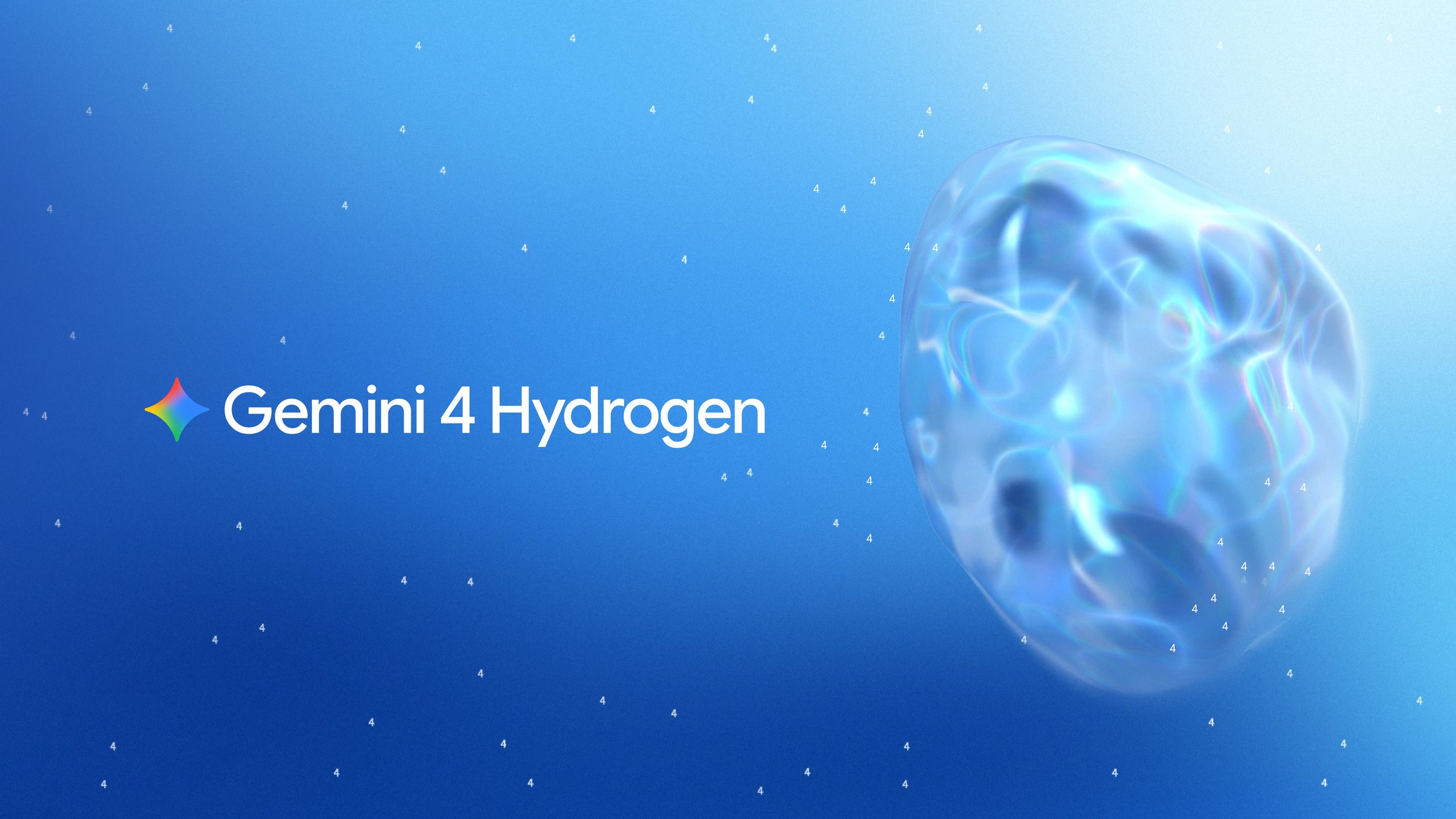
/ Google's Gemini 4 Hydrogen replaces 3.8 Flash in Search and the Gemini app. Here's what's new, who gets it free, what it costs and how it compares to rivals.
by Hozefa Khety
· 7 min read
Google has released Gemini 4 Hydrogen, a faster and cheaper member of its new Gemini 4 family. It replaces Gemini 3.8 Flash as Google's everyday model and went live on Thursday, November 12, 2026, rolling out globally in Google Search, the Gemini app and Google's developer tools.
Google calls Hydrogen its way of "bringing cutting-edge intelligence to everyone." It is built for quick everyday tasks rather than the long, deep reasoning jobs Google aims at its bigger Gemini 4 Carbon and Gemini 4 Argon models. Here is what changes for you, who gets it, what it costs and how it compares.
What is Gemini 4 Hydrogen?
Hydrogen is the speed-focused model in the Gemini 4 line, effectively the successor to Google's older Flash models, even though it drops the Flash name. Google's elemental names can be confusing, so here is the short version: Carbon is the most powerful model, Argon is the frontier model that came before it, and Hydrogen is the fast, affordable one meant for everyday use.
Google says Hydrogen finishes tasks 2.5 times faster than Gemini 3.8 Flash at its default setting and makes fabricated claims, the made-up facts AI models sometimes produce, more than five times less often. It also says Hydrogen recovers better when a tool fails or a web search comes back empty.
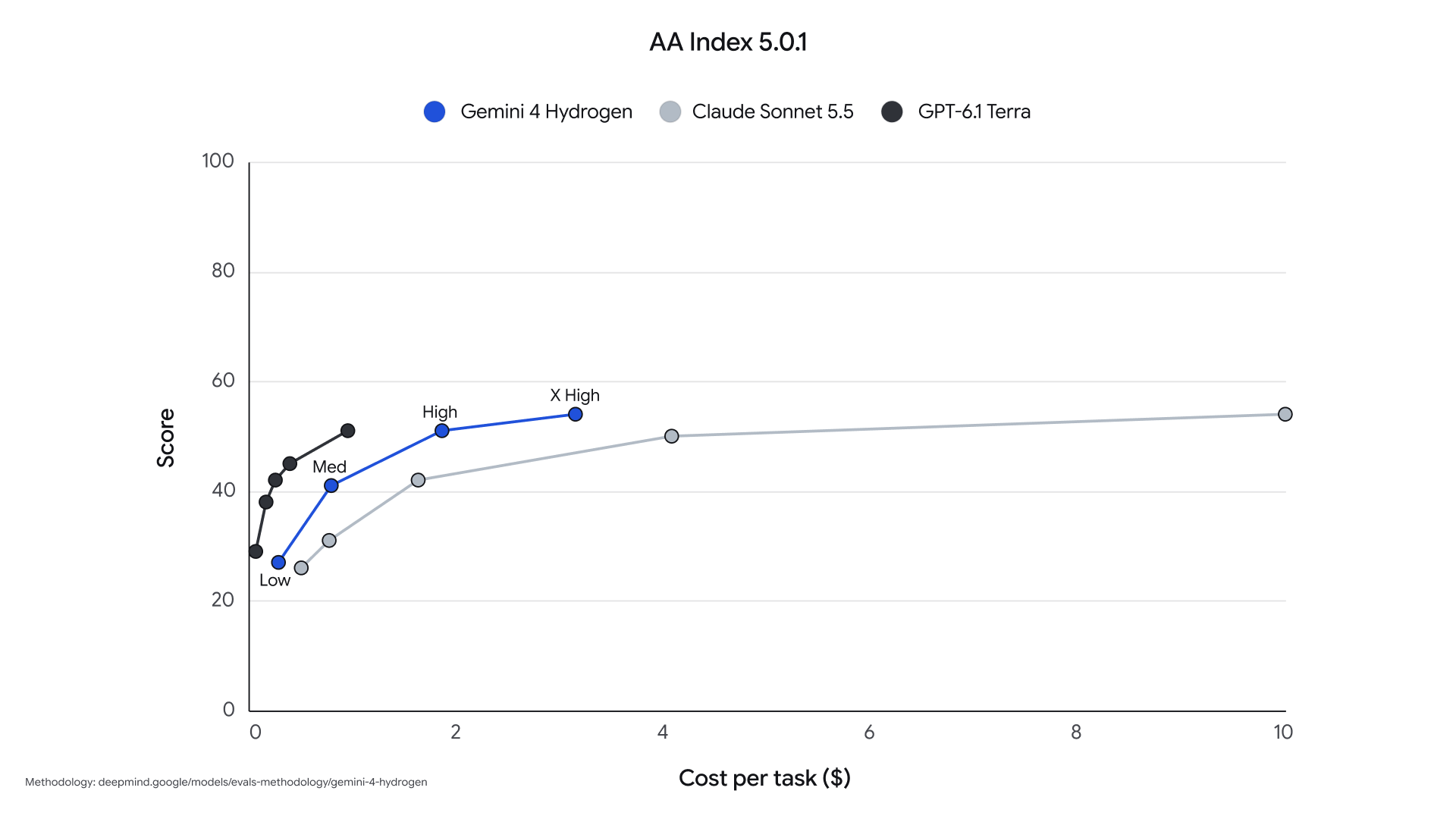
Surprisingly, Google says Hydrogen even edges out the bigger Argon on the Artificial Analysis Intelligence Index, an independent score that combines many tests: 51 versus 50 at Hydrogen's default "high" thinking level, and 54 at its new top "xhigh" level.
What changes in Google Search
This is the change most people will notice. Robby Stein, Google's VP of Product for Search, calls Hydrogen "the biggest model upgrade to Search yet," and it is available in Search for all users worldwide. It is now the default model in AI Mode and handles the hardest questions in AI Overviews, the AI summaries at the top of some search results, according to Stein.
Google says Search with Hydrogen understands long, messy questions better, including questions with several parts, typos or very specific requests, and tries to answer each part. Answers should be more visual, with more images, comparison tables and custom tools, and Google says an upgraded "query fan-out" (running many related searches at once behind the scenes) links to a wider range of websites. Google also promises better answers in every language AI Mode supports.
Who gets Hydrogen in the Gemini app
In the Gemini app, Hydrogen appears in the model menu as "Everyday help," according to 9to5Google. Google says it sticks more closely to your tone, format and instructions, so drafts and documents need less back-and-forth, and that it is better at pulling in context from Gmail, Google Drive and connected apps such as Airtable and Dropbox.
Access depends on your plan. On Google's US plans page (checked November 13, 2026, 13:26 UTC), Google AI Plus ($4.99 a month) now lists Gemini 4 Hydrogen as its headline model, Google AI Pro ($19.99 a month) includes Hydrogen and Argon, and Google AI Ultra (from $99.99 a month) has the highest limits for Hydrogen, Argon and Carbon. Prices vary by country.
Free users cannot pick Hydrogen themselves. Google says free accounts get it through automatic model selection "when it's the appropriate model for the prompt," and Notebookcheck reports that Google's help pages say most free prompts still go to the lighter Flash-Lite model. If you switch automatic model selection off, a free account uses Flash-Lite only.
Gemini 4 Hydrogen price for developers
For developers, Hydrogen costs $1.50 per million input tokens and $7.50 per million output tokens, priced the same across its whole 1 million-token context window, according to Google. Ars Technica notes that this is the same price as Gemini 3.8 Flash, and The Decoder reports cached input costs $0.075 per million tokens. A token is a small chunk of text, roughly three-quarters of a word.
Hydrogen can take in up to 1 million tokens and, on its long-output setting, write up to 1 million tokens back. It offers four thinking levels: low, medium, high (the default) and a new xhigh level, so developers can trade speed and cost for deeper reasoning. It is available through the Gemini API in Google AI Studio and Android Studio, in Gemini for business, in Gemini in Google Sheets for Google AI Pro and Ultra subscribers, and in Google's Antigravity coding tool for Google AI Pro and Ultra subscribers.
For comparison, Ars Technica reports that Carbon and Argon cost $2 and $10 per million input and output tokens today, rising to $4 and $20 next month, which makes Hydrogen the clear budget option in the family.
How Hydrogen compares with ChatGPT and Claude models
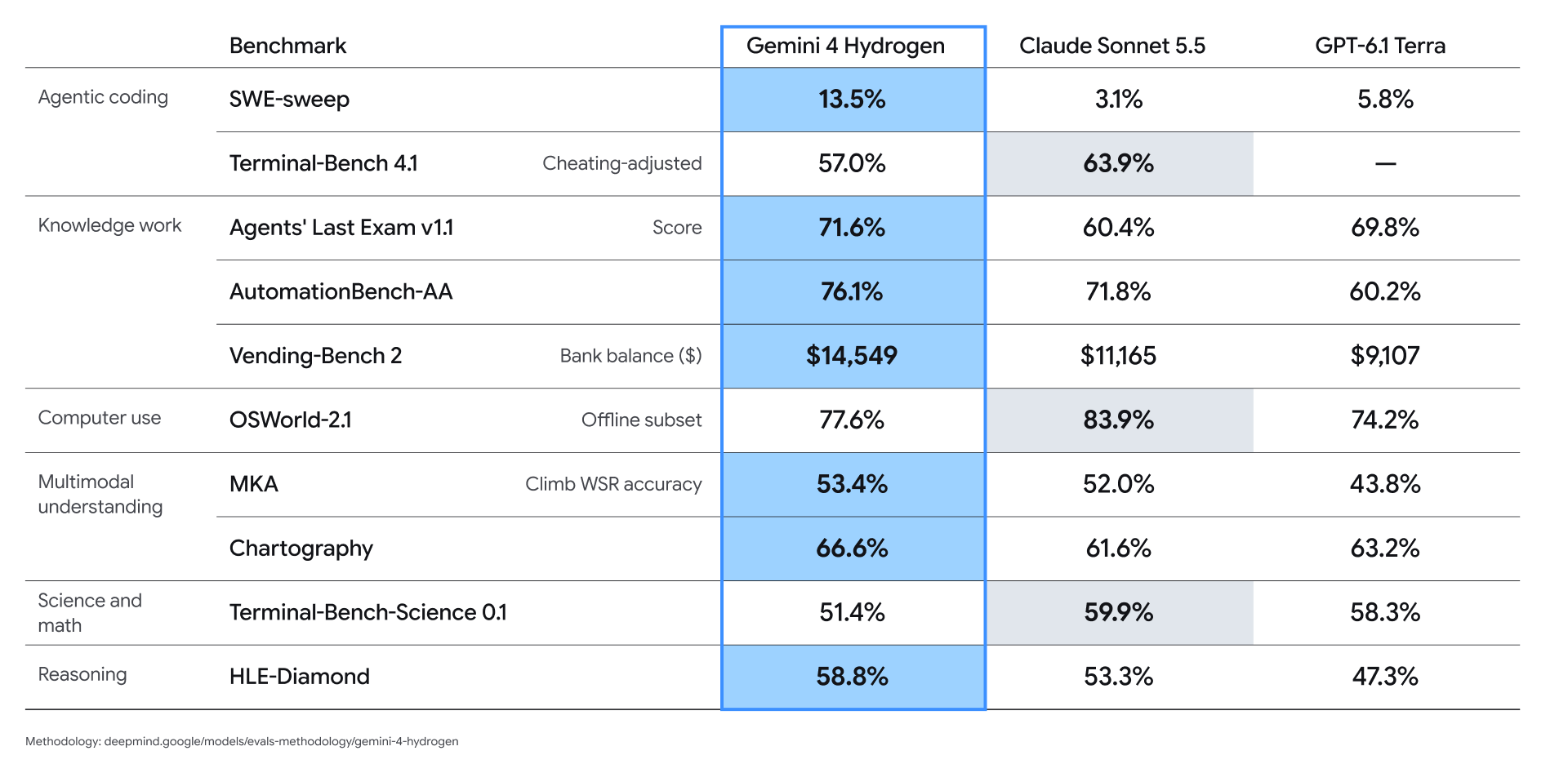
Google compares Hydrogen with Anthropic's Claude Sonnet 5.5 and OpenAI's GPT-6.1 Terra, two mid-tier models from its rivals. In Google's own table, Hydrogen leads on tests of knowledge work, chart reading and spotting bugs in code, while Claude Sonnet 5.5 comes out ahead on terminal coding tasks, computer use and a science test.
Independent testing tells a similar story. According to The Decoder, Artificial Analysis found Hydrogen made things up only 8% of the time on its AA-Omniscience test, but it trailed Claude Sonnet 5.5 on terminal-based coding work. Artificial Analysis put Hydrogen's average cost at about $1.87 per task at the high level and $3.16 at xhigh, around a third of Claude Sonnet 5.5's cost at its maximum setting.
Safety: fewer overreaching actions
Because Hydrogen is meant to run tasks on its own, Google focused on keeping it in bounds. Compared with 3.8 Flash, Google says Hydrogen is up to 2x less likely to bypass permission limits when a task is impossible or blocked, and more than 2.3 times more resistant to hidden instructions planted in web pages or files, a trick known as prompt injection. Mashable notes that, like all AI models, Hydrogen can still get things wrong.
Google also introduced Orchestrator in Antigravity, which switches between Carbon and Hydrogen within one session. Google says it nearly matched Carbon's success rate on a coding benchmark while using 24% less of a user's quota and finishing 19% faster.
Should you care?
If you use Google Search, you already have Hydrogen: AI Mode and the harder AI Overviews now run on it, so expect longer, more visual answers and more links. If you pay for Google AI Plus, Pro or Ultra, pick "Everyday help" in the Gemini app model menu to use it directly.
Free Gemini app users get Hydrogen only some of the time, when Google's automatic model picker decides a prompt needs it. And for developers on Gemini 3.8 Flash, Hydrogen is a drop-in upgrade at the same price, with big gains in Google's tests, though it is worth running your own checks before switching.
See more of The Threshold on Google
Add us as a preferred source to see more of our stories in your Top Stories.
Frequently asked questions
What is Gemini 4 Hydrogen?
Gemini 4 Hydrogen is Google's fast, lower-cost AI model in the Gemini 4 family, released November 12, 2026. It replaces Gemini 3.8 Flash for everyday tasks, coding and AI agents, while Gemini 4 Carbon and Argon handle the hardest reasoning work.
Is Gemini 4 Hydrogen free?
Partly. It is free in Google Search for all users, where it powers AI Mode and the hardest AI Overviews. In the Gemini app, free users get it only through automatic model selection when Google decides a prompt needs it; paid plans can choose it directly.
Which Gemini plans include Gemini 4 Hydrogen?
On Google's US plans page, Google AI Plus ($4.99 a month), Google AI Pro ($19.99 a month) and Google AI Ultra (from $99.99 a month) all include Gemini 4 Hydrogen, with higher usage limits on the more expensive plans. Prices vary by country.
How much does the Gemini 4 Hydrogen API cost?
Google charges $1.50 per million input tokens and $7.50 per million output tokens, flat across the full 1 million-token context window. That is the same price as Gemini 3.8 Flash. Cached input costs $0.075 per million tokens, according to The Decoder.
Is Gemini 4 Hydrogen better than Gemini 4 Argon?
On the Artificial Analysis Intelligence Index, Google says Hydrogen scores 51 at its default level versus 50 for Argon, and 54 at its top xhigh level. Google still recommends Carbon and Argon for deep, long-running reasoning tasks.
How do I use Gemini 4 Hydrogen?
Use Google Search's AI Mode, which now runs on Hydrogen by default. In the Gemini app on a paid plan, choose "Everyday help" in the model menu. Developers can call the gemini-4-hydrogen model through the Gemini API in Google AI Studio.
What are Gemini 4 Hydrogen's thinking levels?
Hydrogen has four thinking levels: low, medium, high (the default) and a new xhigh level. Higher levels reason longer for better answers but take more time and cost more; Artificial Analysis measured about $1.87 per task at high and $3.16 at xhigh.
How does Gemini 4 Hydrogen compare with Claude Sonnet 5.5 and GPT-6.1 Terra?
In Google's own tests, Hydrogen leads on knowledge work, chart reading and finding bugs in code, while Claude Sonnet 5.5 leads on terminal coding, computer use and a science benchmark. Independent tests by Artificial Analysis found Hydrogen rarely made things up but trailed Sonnet on terminal work.