Gemini 4 Carbon: price, access and benchmarks

/ Google's Gemini 4 Carbon tops the Artificial Analysis index, but only vetted cyber defenders can use it. Here's the price, access, benchmarks and safety data.
by Hozefa Khety
· 9 min read
Google has announced Gemini 4 Carbon, a new frontier AI model that it calls its strongest yet, with a focus on cybersecurity and long, multi-day tasks. It was unveiled on Wednesday, October 28, just over two weeks after Gemini 4 Argon reached general availability, and it immediately took the top spot on the independent Artificial Analysis Intelligence Index.
There is a catch: almost nobody can use it yet. Carbon is starting with a small group of vetted cyber defenders, and Google has not given a date for developers, businesses or the Gemini app. Here is what Carbon is, who gets it first, what it will cost, how its benchmarks compare with GPT-6 Astra and Claude Opus 5.5, and what Google says it did on safety.
What is Gemini 4 Carbon?
Gemini 4 Carbon is the second model in Google's Gemini 4 family, after Argon. In the announcement, Koray Kavukcuoglu, Google DeepMind's chief AI architect, describes it as "our strongest model with state-of-the-art cybersecurity and long horizon capabilities." Google says Carbon can keep working on a complex task for days, and that it is better than Argon at coding, agent work, science and maths.
Artificial Analysis lists a 1 million token context window and text, image, video and speech input, with text output. Google's own post does not include a model ID for developers yet.
Not everyone sees a big leap. Ars Technica's Ryan Whitwam writes that Carbon looks like a slightly better version of Argon that "could be a post-training upgrade of Argon," and notes that many of its leads over rival models are only a few points. That is a fair reading of the numbers below: Carbon wins most of Google's chosen tests, but rarely by a wide margin.
Who can use Gemini 4 Carbon right now?
Access is limited on purpose. Google says Carbon is rolling out "starting this week" to a subset of cyber defenders, then in phases to more trusted partners through its Fairwind Program. Developers, businesses and consumers will get it "as soon as possible," according to Google, which did not commit to a date. Google also says it took part in the US government's voluntary pre-release testing for the model.
Fairwind is Google DeepMind's program for organizations that defend networks. Its page says it has more than 650 partners worldwide and prioritizes governments and national cyber authorities, critical infrastructure such as healthcare, telecoms, energy and finance, and core technology platforms. Members go through vetting, must use phishing-resistant multi-factor authentication and cannot resell access. Organizations can apply through a form, but there is no self-serve sign-up.
When will everyone else get it? Google will not say. Ars Technica suggests it could take "a couple of weeks" if Carbon follows Argon's path, likely starting with the Gemini API and the top Google AI Ultra plan. Treat that as informed speculation, not a schedule. For reference, Argon was announced on September 30 and became generally available on October 13 in the Gemini API, AI Studio, the Gemini app and AI Mode for paid plans.
Gemini 4 Carbon price
Google has published API pricing even though the API is not open to the public yet. During an introductory period, Carbon costs $2 per million input tokens and $10 per million output tokens, with cached input 95% cheaper. After the introductory period, the price doubles to $4 per million input tokens and $20 per million output tokens. The Verge reports the same figures.
That is exactly the same as Gemini 4 Argon, which is $2 and $10 through November 30 and $4 and $20 from December 1. Google has not said when Carbon's discount ends; Ars Technica says Google declined to give an end date. There is no word on a free tier, and Argon itself is not on the free tier of the Gemini API.
Per-token prices only tell part of the story, because models use different amounts of tokens. Artificial Analysis, using the standard $4 and $20 price, says Carbon costs $7.76 per task in its Intelligence Index. That is about 23% less than Claude Opus 5.5 at max effort ($10.04) but about 1.2 times GPT-6 Astra at max effort ($6.25), and almost the same as Argon ($7.68) while scoring 9 points higher.
Benchmarks: what Google says
Google's evaluation table compares Carbon with Argon, OpenAI's GPT-6 Astra, and Anthropic's Claude Opus 5.5 and Claude Fable 5.1 across 17 tests. Carbon has the top score in 15 of them. The two exceptions are FrontierSWE 2, a coding test where GPT-6 Astra leads with 65.5% to Carbon's 61.2%, and OSWorld-2.1, a test of operating a computer, where Claude Opus 5.5 leads with 87.2% to Carbon's 81.5%.
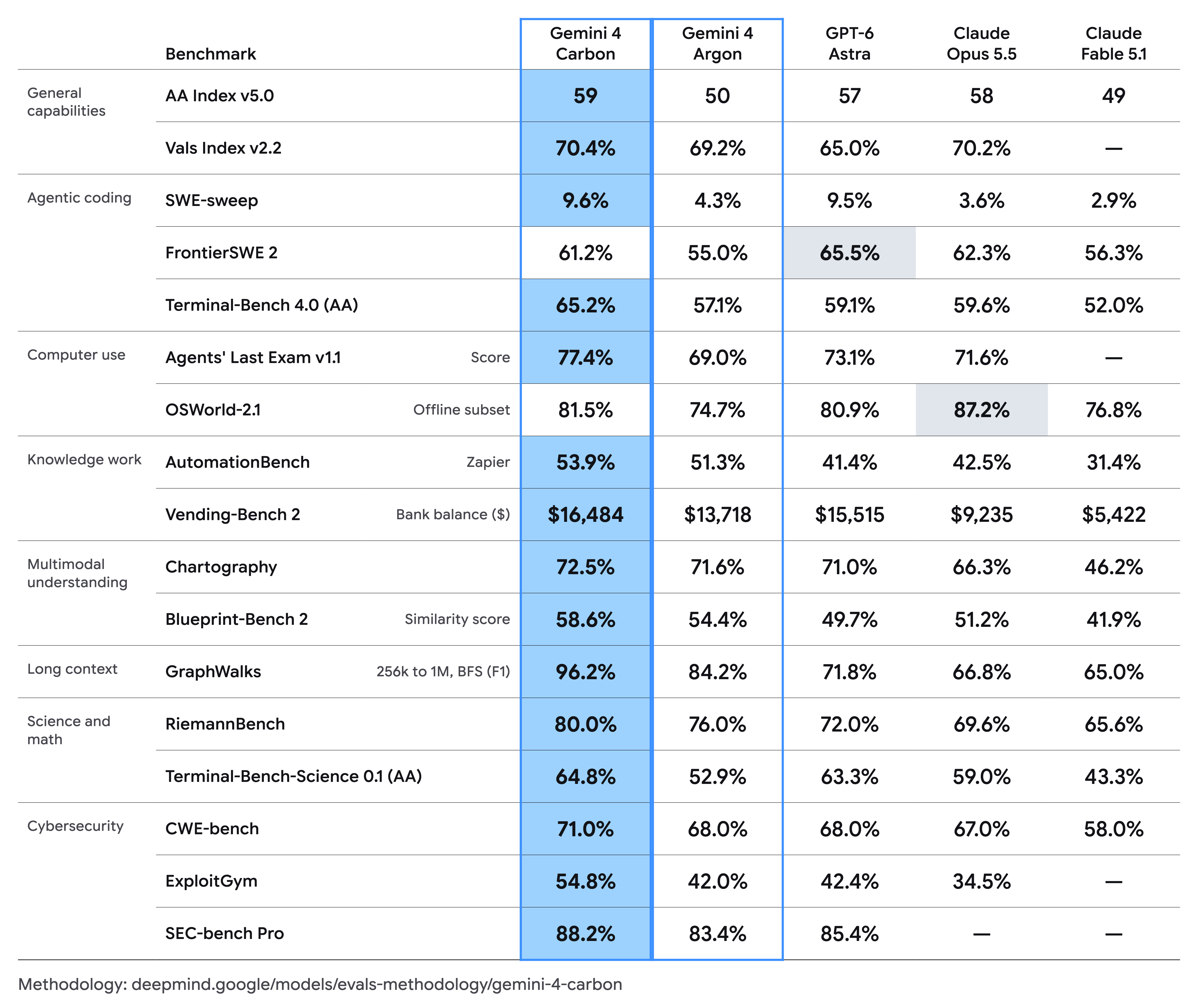
Some of the more notable rows: Carbon scores 65.2% on Terminal-Bench 4.0 against 59.6% for Opus 5.5 and 59.1% for GPT-6 Astra, and 77.4% on Agents' Last Exam against 73.1% for Astra. In Vending-Bench 2, a simulation of running a small business, it finishes with $16,484 against $15,515 for Astra. The biggest gap is on GraphWalks, a long-context reasoning test, where Carbon scores 96.2 against 84.2 for Argon and 71.8 for Astra.
Elsewhere the margins are thin. On the Vals Index, Carbon scores 70.4 and Opus 5.5 scores 70.2. On SWE-sweep, Carbon's 9.6 edges GPT-6 Astra's 9.5. Google adds that Carbon climbed 89 Elo points on the WebDev Arena leaderboard to fourth place. As always, these are tests chosen and published by Google; its methodology is posted on the Google DeepMind site.
Benchmarks: what Artificial Analysis found
The independent check is more useful. Artificial Analysis says Gemini 4 Carbon, at high reasoning effort, scores 59 on its Intelligence Index v5, the new number one ahead of Claude Opus 5.5 at 58 and GPT-6 Astra at 57. Argon scores 50. The firm launched version 5 of the index only a day earlier, on October 27, and says 60% of it now uses private test sets.
Carbon has the best score in four of the nine tests in the index: HLE-Diamond, Terminal-Bench-Science, AA-Omniscience and AutomationBench-AA. On the separate Coding Agent Index, run through Google's Antigravity CLI, it scores 59, three points behind Claude Code with Opus 5.5 at max effort (62). Artificial Analysis notes that Google has historically underperformed in coding agents, so second place stands out.
Carbon is not the best at office-style work. On the AA-Briefcase knowledge-work test, it scores 1609 Elo, 126 points better than Argon but behind Grok 4.7, Muse Wonder and Kimi K3.1 Pro. One mixed result: on AA-Omniscience, Carbon is more accurate than Argon (58% correct versus 48%), but its hallucination rate rose from 4% to 11%. Artificial Analysis says that is still the second lowest of any model, against 50% for both Claude Opus 5.5 and GPT-6 Astra at max effort.
Why Carbon is a cybersecurity model first
Cybersecurity is the main reason for the limited rollout. Google says Carbon is state of the art at finding and fixing security flaws, and reports 88.2% on SEC-bench Pro, 54.8% on ExploitGym and 71.0% on CWE-bench, which is run by Collinear. Google says these scores were measured without guardrails.
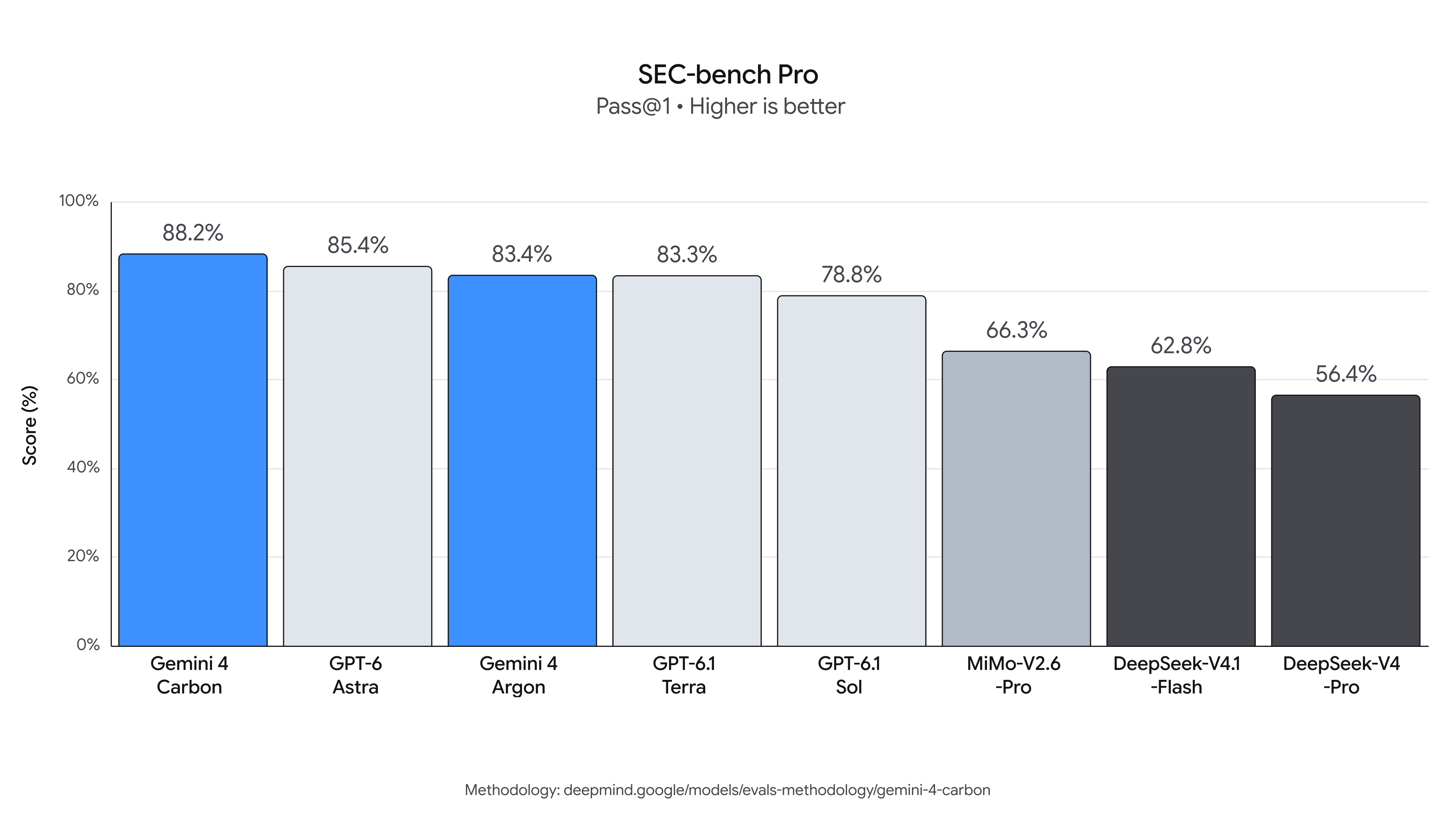
Google says that on internal benchmarks Carbon succeeds at writing secure code more than twice as often as Argon. It also quotes its Chrome security team, which found Carbon was "more than 10X better than another lab's large frontier model" at generating high-quality patches, without naming the other lab. Security company Wiz says Carbon leads its web penetration-testing benchmarks.
The same skills that help defenders patch bugs could help attackers find them, which is why Google is putting Carbon in the hands of vetted defenders first. Whether a broader release keeps extra cyber guardrails in place is something Google has not spelled out.
What Google says about safety
Google spent a large part of its announcement on safety numbers. It says Carbon cheated on Terminal-Bench 4.0 tasks 0.0% of the time and attempted to in 0.4% of cases. High-severity misalignment alerts fell by almost 80% compared with Argon, and Carbon made roughly half as many unsupported claims as Argon in Google's testing. Google also reports a 26% drop in overreach, where a model does more than asked, and a 29% drop in under-service, where it does less.
On prompt injection, a way of hijacking an AI agent with hidden instructions on a web page or in a document, Google cites Gray Swan's indirect prompt injection test. Carbon had a 0% attack success rate, against 0.7% for Argon, 1.0% for Claude Opus 5.5 and 8.5% for GPT-6 Astra.
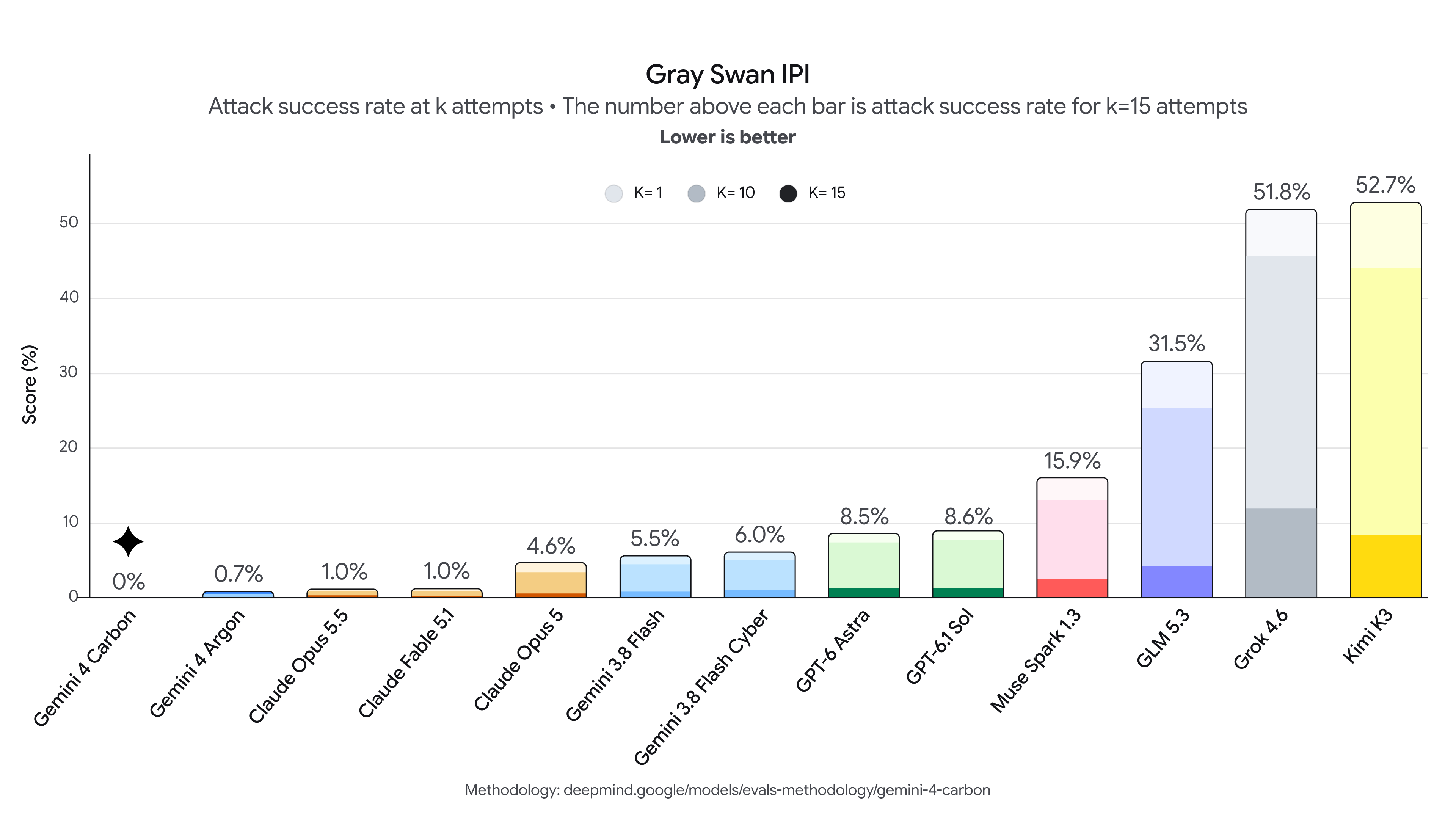
These are Google's own measurements, and some are internal tests that cannot be independently checked. The Artificial Analysis hallucination result above is a reminder that "safer" on one measure does not mean better on all of them.
Gemini 4 Carbon vs GPT-6 Astra vs Claude Opus 5.5
On overall intelligence, the three are close: 59 for Carbon, 58 for Opus 5.5 and 57 for GPT-6 Astra on Artificial Analysis's index. Carbon stands out on long-context reasoning, science and cybersecurity tests, and on cost compared with Opus 5.5. Opus 5.5 still leads on coding agents and computer use, and GPT-6 Astra leads on FrontierSWE 2 and is cheaper per task in Artificial Analysis's testing.
The real difference today is availability. GPT-6 Astra and Claude Opus 5.5 can be used now by paying customers. Carbon cannot, unless you are a vetted Fairwind partner. If you need a Google model today, Gemini 4 Argon is the one on offer, at the same price Carbon will have.

The bottom line
Gemini 4 Carbon gives Google the top score on the leading independent AI ranking, a strong showing in coding agents and a clear cybersecurity pitch, at the same price as Argon. But the gains over Argon are incremental on many tests, rivals still lead in coding and computer use, and there is no public release date or end date for the launch discount.
For most developers and Gemini users, nothing changes this week. If you are on a security team at a government agency, critical infrastructure operator or major platform, the Fairwind application is the way in. Everyone else should watch for Google to open Carbon in the Gemini API and its paid Gemini plans, which on Argon's timeline could be weeks away.
See more of The Threshold on Google
Add us as a preferred source to see more of our stories in your Top Stories.
Frequently asked questions
What is Gemini 4 Carbon?
Gemini 4 Carbon is Google's newest frontier AI model, announced on October 28, 2026. Google calls it its strongest model, with state-of-the-art cybersecurity skills and the ability to work on long tasks for days.
Can I use Gemini 4 Carbon now?
Not unless you are a vetted cyber defender. Google is starting with a subset of cyber-defense organizations, then expanding to trusted partners in its Fairwind Program. Developers, businesses and consumers will get it "as soon as possible," with no date given.
How much does Gemini 4 Carbon cost?
API pricing is $2 per million input tokens and $10 per million output tokens during an introductory period, rising to $4 and $20 afterwards. Cached input is 95% cheaper. Google has not said when the introductory price ends.
When will Gemini 4 Carbon be available to everyone?
Google has not announced a date. Ars Technica suggests it could be a couple of weeks if Carbon follows Gemini 4 Argon, which went from announcement on September 30 to general availability on October 13.
Is Gemini 4 Carbon better than GPT-6 Astra and Claude Opus 5.5?
On Artificial Analysis's Intelligence Index v5, Carbon scores 59, ahead of Claude Opus 5.5 at 58 and GPT-6 Astra at 57. Opus 5.5 still leads on coding agents and computer use, and GPT-6 Astra leads on FrontierSWE 2.
What is the Fairwind Program?
Fairwind is Google DeepMind's program for organizations that defend computer networks. It has more than 650 partners and prioritizes governments, critical infrastructure and major tech platforms. Members are vetted and must use phishing-resistant multi-factor authentication.
How is Gemini 4 Carbon different from Gemini 4 Argon?
Carbon scores higher on most of Google's tests, more than doubles Argon's secure-code success rate on Google's internal benchmarks and scores 9 points higher on the Artificial Analysis index. It has the same API price. Argon is available now; Carbon is not.
Is Gemini 4 Carbon free?
Google has not mentioned a free tier for Carbon. Gemini 4 Argon is not on the free tier of the Gemini API either.