Kimi K3.1 Pro: price, access and how it compares
/ Moonshot's Kimi K3.1 Pro rivals Claude Opus 5.5 on coding at half the API price, with open weights due by Nov 4. Here's the price, how to use it and the catch.
by Hozefa Khety
· 7 min read
Moonshot AI has released Kimi K3.1 Pro, a new version of its flagship AI model that it says nearly matches the best closed models from Anthropic and OpenAI on coding and agent tasks, at half the API price of Claude Opus 5.5. It launched on Friday, October 23, and is already live in the Kimi app, on Kimi.ai, in the Kimi Work desktop app, in Kimi Code and through the Kimi API.
The bigger promise is openness. Moonshot says the full model weights will be published by November 4, 2026. If that happens, independent benchmarking firm Artificial Analysis says K3.1 Pro will become the highest-scoring open-weights model it tracks. Here is what the model is, what it costs, how to use it, and what to watch out for.
What Kimi K3.1 Pro is
Kimi K3.1 Pro is a post-trained version of Kimi K3, the model Moonshot launched in July, built with much more reinforcement learning compute. Moonshot calls it its most capable 3T-class open-weight model. Artificial Analysis lists it at 2.8 trillion total parameters with 104 billion active, a context window of 1 million tokens, and text and image input.
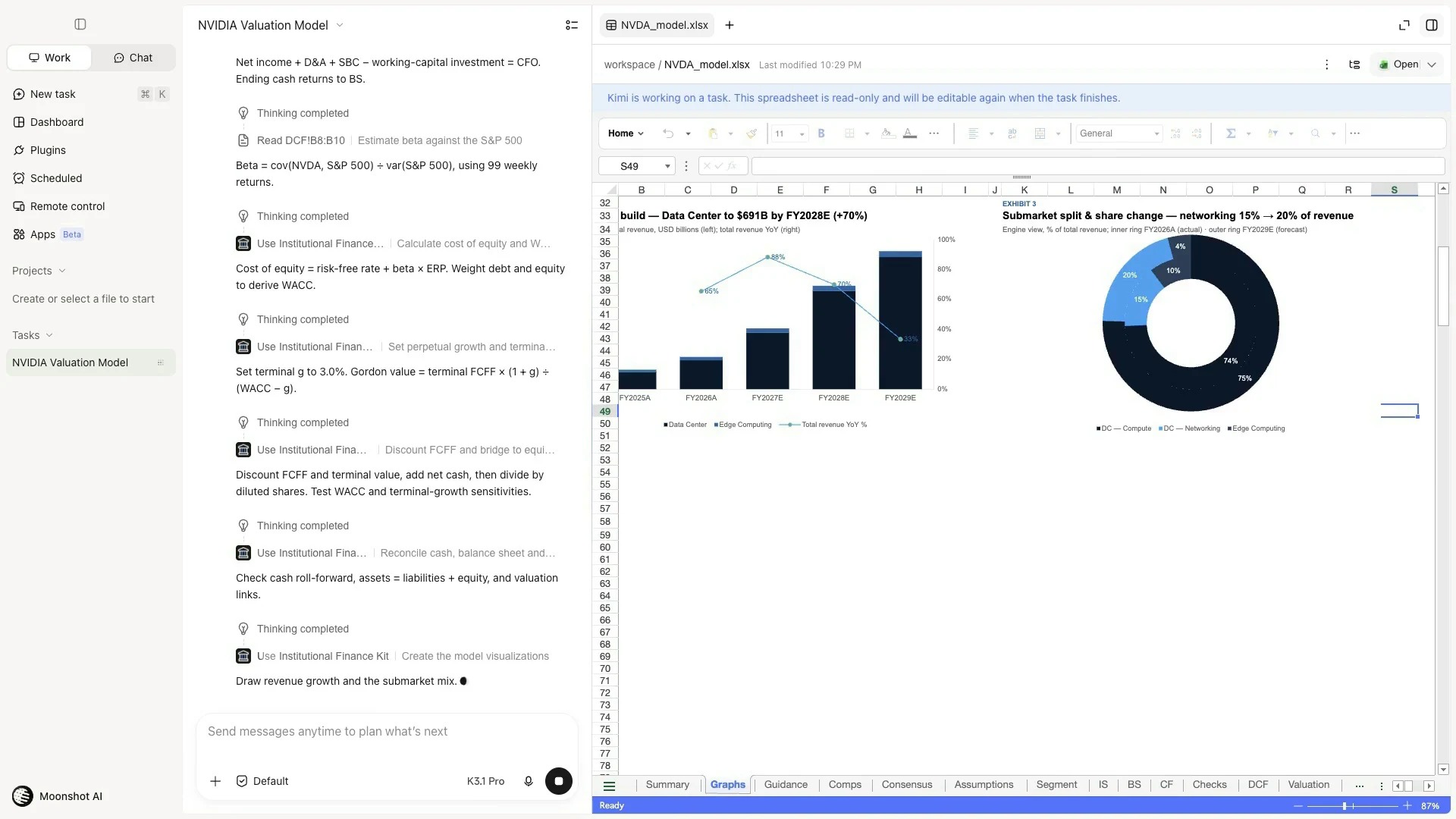
Alongside it comes Kimi K3.1 Pro Highspeed, the same model served 2 to 3 times faster for more responsive chats and coding sessions. Moonshot says the model improves on coding, 3D creation, financial research and agent work, where it can run long, multi-step tasks on its own.
Kimi K3.1 Pro price: app plans and API
You can try K3.1 Pro free with limited usage on Kimi.ai and in Kimi Work. Paid Kimi plans, billed annually, work out to $15 a month for Plus, $31 for Pro, $79 for Max and $159 for Ultra. Plus adds K3.1 Pro in Kimi Code. Pro and above add the faster Highspeed version across Kimi on the web, Kimi Work and Kimi Code, while Max and Ultra add extra-long chats of up to 1 million tokens and higher limits.
For developers, the API costs $2 per million input tokens, $10 per million output tokens and $0.20 per million cached input tokens, with flat pricing across the whole 1-million-token window. That is one-third less than Kimi K3, which is listed at $3 and $15. Highspeed doubles the regular input and output rates to $4 and $20. For comparison, Claude Opus 5.5 and Meta's Muse Wonder are $4 and $20, and GPT-6 Astra is $10 and $50. Membership plans do not cover API use, which is billed separately.
How to use Kimi K3.1 Pro
On a phone, update the Kimi app on iOS, Android or HarmonyOS, or open kimi.ai in a browser. On a computer, install Kimi Work version 3.1.0 or later for Windows or Apple silicon Macs. In Kimi Code, Moonshot's coding agent, type the /model command and pick Kimi K3.1 Pro.
Developers can select kimi-k3.1-pro or kimi-k3.1-pro-highspeed on the Kimi API Platform, and Zero Data Retention is available for API customers. The model always reasons before answering, but you can set reasoning effort to low, high or max, with max as the default. Businesses on Kimi Enterprise get it switched off by default, so an administrator has to turn it on.
Kimi K3.1 Pro benchmarks
Artificial Analysis gives K3.1 Pro a score of 55 on its Intelligence Index, up 11 points from Kimi K3 and fourth overall, behind only Claude Opus 5.5 (58), Claude Sonnet 5.5 (56) and Muse Wonder Full (56). It also scored 67% on Terminal-Bench 4.0, the top result in Artificial Analysis's own testing, and estimates the cost per task at about $1.98, roughly the same as K3 because the new model writes 14% more tokens.
Moonshot's own numbers are a little more modest. It reports 65.7% on Terminal-Bench 4.0, ahead of GPT-6 Astra at 58.2% but narrowly behind Claude Opus 5.5 at 66.4%. On BenchCAD, which tests turning images of objects into 3D CAD models, it reports 92.7% with tools, against 96.2% for Opus 5.5 and 95.9% for GPT-6 Astra. Most other figures come from Moonshot's internal benchmarks, so treat them as the company's claims until more independent tests arrive.
Fewer made-up facts, and less hacking ability
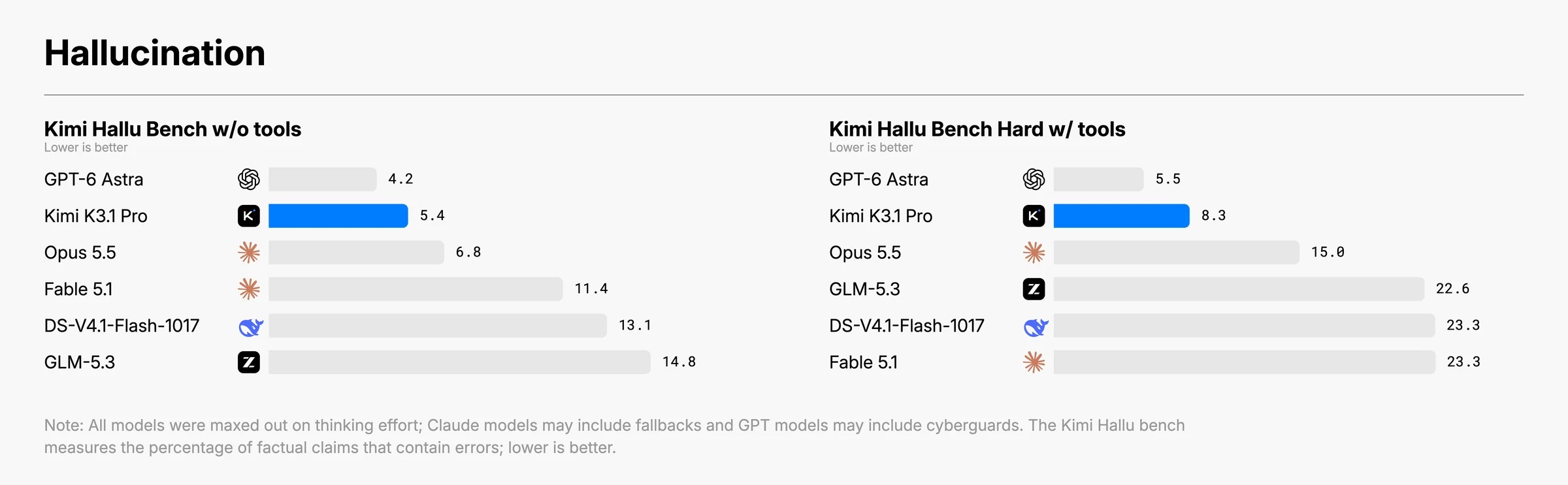
Moonshot says it worked on accuracy for finance and research tasks. On its internal Kimi Hallu Bench Hard stress test, the share of claims containing errors fell from 23.4% for K3 to 8.3%. The company stresses that the test is deliberately tough and does not reflect error rates in daily use. Artificial Analysis also saw an improvement, with its hallucination rate falling from 53% to 44%.
Because the weights will be public, Moonshot also says it removed cyberattack-related data from training to limit misuse. On its in-house exploit test, xdev-bench-hard, a version trained without those cuts solved 90.5% of tasks, while the released K3.1 Pro solves 81.0%. Moonshot says the model's hacking ability remains behind frontier closed models that have been public for at least three months.

3D Make and other new features
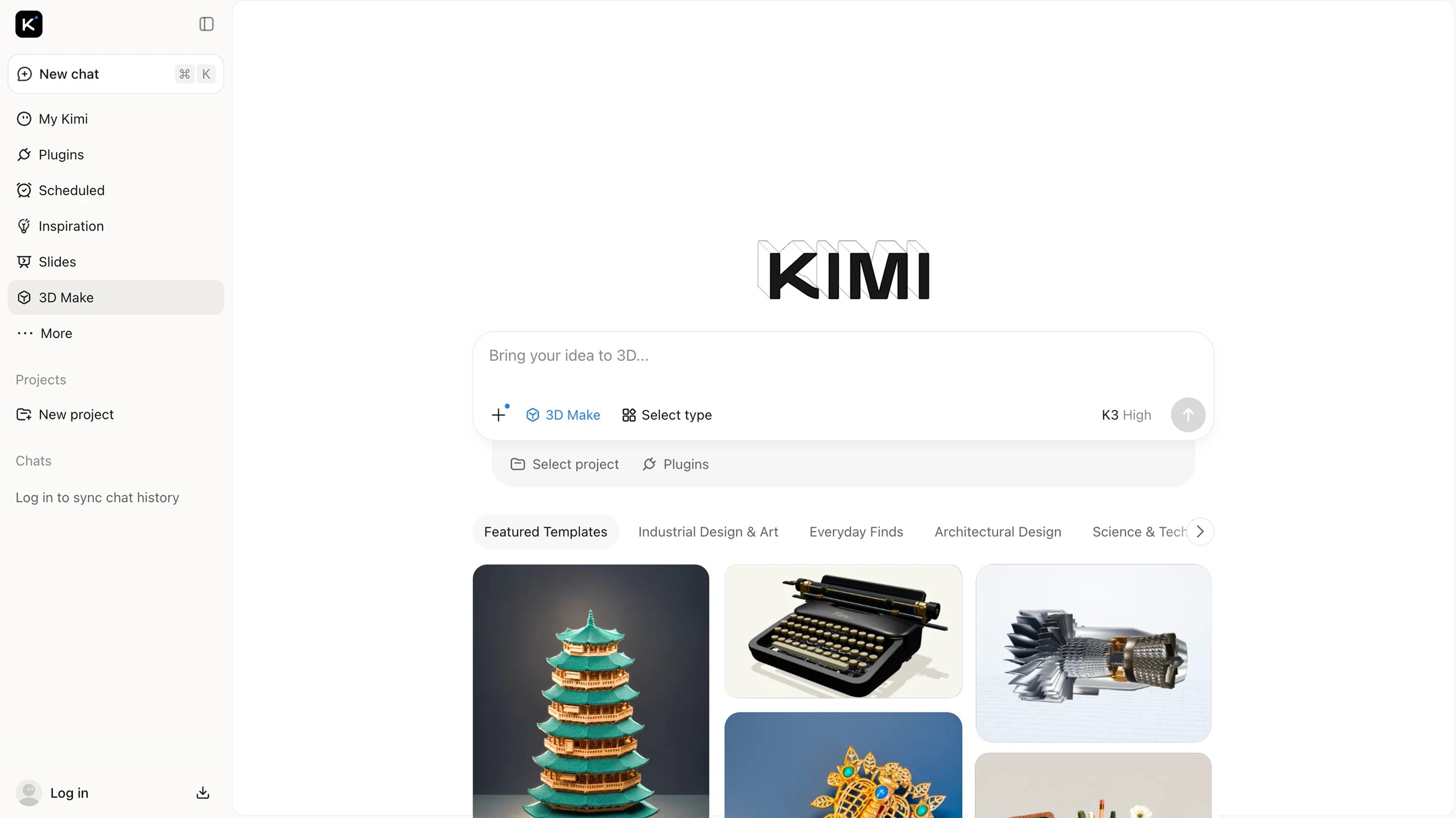
Moonshot is leaning on 3D design as a headline feature. K3.1 Pro can work from a text brief, a sketch or a reference image to build 3D models, and can write scripts for tools such as Blender and CAD software. A new 3D Make mode on kimi.ai and in the Kimi app lets you preview and edit models online, download them ready for 3D printing, or export them as videos or Live Photos.
The model also targets coding with game engines such as Unity, Unreal Engine and Godot, and finance work such as building spreadsheet models. Moonshot reports a state-of-the-art 64.4 on the OfficeQA Pro v2 financial documents benchmark.
The influencer marketing question
The launch has not been entirely smooth. VentureBeat reported that an X user posted screenshots of what was presented as a brief for creators promoting K3.1 Pro, including the line "Please DO NOT put on the paid partnership label". The document has not been verified, it is not clear who wrote it, and VentureBeat said Moonshot had not publicly responded as of October 25. Still, it is a reason to treat glowing social media posts about the model with some caution and look at independent tests instead.
What it means
Kimi K3.1 Pro is the strongest sign yet that open models are catching up with the best closed ones, and it is far cheaper to run than Opus 5.5 or GPT-6 Astra. For everyday users, the free tier and the $15 Plus plan are an easy way to try it. For developers, the key date is November 4: if the weights arrive as promised, anyone with enough hardware will be able to run a near-frontier model themselves.
See more of The Threshold on Google
Add us as a preferred source to see more of our stories in your Top Stories.
Frequently asked questions
What is Kimi K3.1 Pro?
Kimi K3.1 Pro is Moonshot AI's newest flagship AI model, released on October 23, 2026. It is a post-trained version of Kimi K3 with a 1-million-token context window, aimed at coding, 3D creation, financial research and agent tasks.
How much does Kimi K3.1 Pro cost?
It is free with limited usage on Kimi.ai and Kimi Work. Paid plans billed annually cost $15, $31, $79 or $159 a month. The API costs $2 per million input tokens and $10 per million output tokens, or $4 and $20 for Highspeed.
Is Kimi K3.1 Pro open source?
Moonshot says the full model weights will be released by November 4, 2026. Until then it is only available through Kimi's apps and the Kimi API.
How do I use Kimi K3.1 Pro?
Update the Kimi app on iOS, Android or HarmonyOS, or go to kimi.ai. You can also use Kimi Work 3.1.0 or later on Windows and Apple silicon Macs, choose it with /model in Kimi Code, or call kimi-k3.1-pro through the Kimi API.
What is Kimi K3.1 Pro Highspeed?
It is the same model served 2 to 3 times faster. In the apps it comes with the Pro, Max and Ultra plans, and on the API it costs twice the standard input and output rates.
Is Kimi K3.1 Pro better than Claude Opus 5.5?
Not overall. Artificial Analysis ranks it fourth on its Intelligence Index with 55, behind Claude Opus 5.5 at 58. It is close on coding, though, and its API is about half the price.
Who makes Kimi?
Kimi is made by Moonshot AI, a Chinese AI company. Its products include the Kimi chatbot app, the Kimi Work desktop app, the Kimi Code coding agent and the Kimi API.
What is the Kimi influencer controversy?
Screenshots posted on X showed what was described as a brief asking creators not to use X's paid partnership label when promoting K3.1 Pro. The document has not been verified, and Moonshot had not publicly responded as of October 25, according to VentureBeat.