OpenAI's First Device Isn't a Phone — It's a Living AI Speaker (2026)
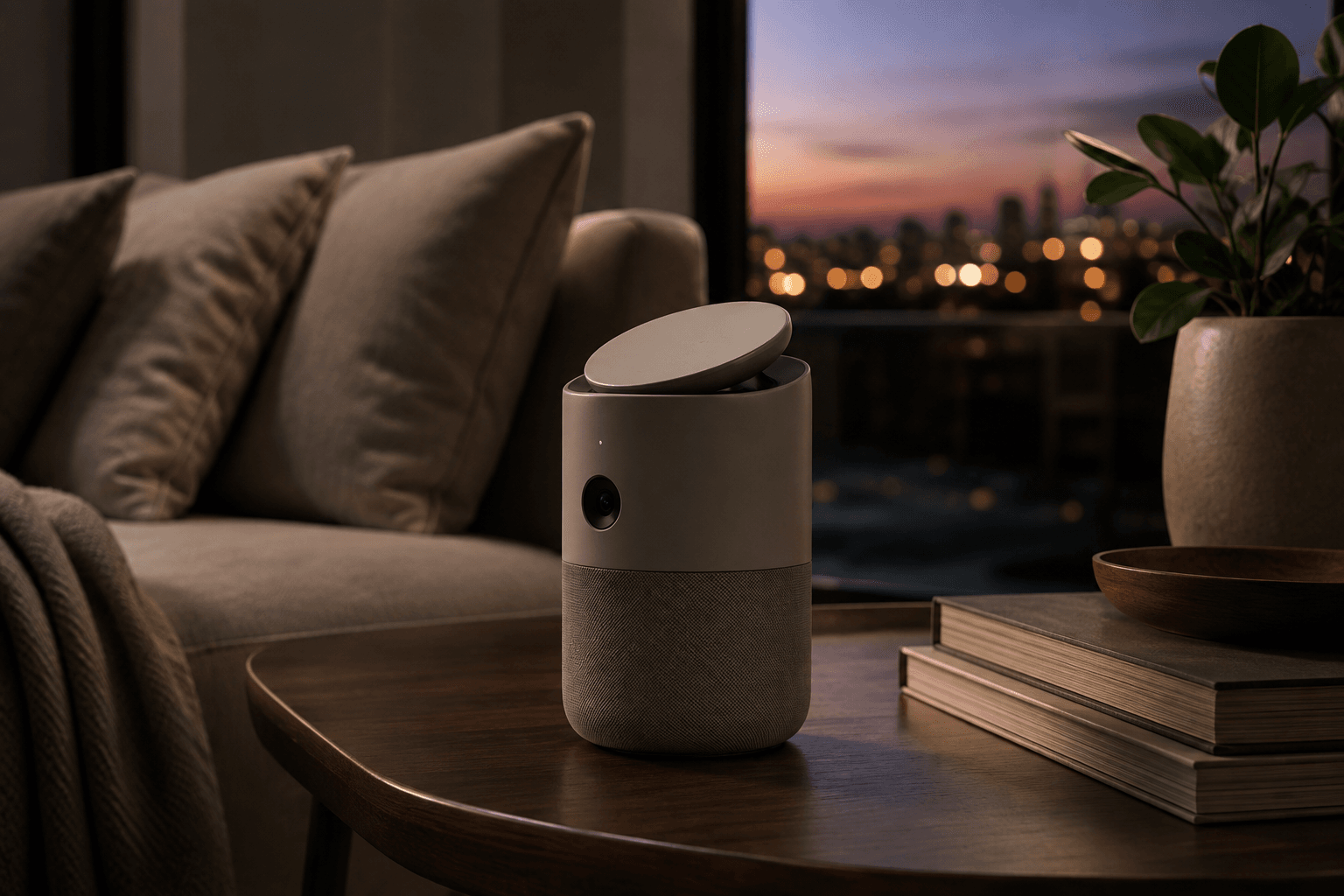
/ OpenAI's first hardware device is reportedly a portable, screenless ChatGPT living speaker — camera, battery, GPT-Live, moving parts — not an AI phone. Unveil eyed for late 2026, launch 2027, with Apple's lawsuit hanging over it.
by Hozefa Khety
· 9 min read
For more than a year, the rumor mill treated OpenAI's first hardware device like a phone waiting to happen — an AI-native handset that would take on the iPhone with agents instead of apps. That was never the first move. According to people familiar with the plans, reported by Bloomberg and corroborated across the tech press, OpenAI's first real consumer product is a portable, screenless AI speaker designed to feel less like Amazon Echo and more like a living companion that sits in your home.
It is still unannounced. It has no official name. Specs are secondhand. But the shape of OpenAI's living speaker is now clear enough to write about: battery-powered, camera-equipped, voice-first, with mechanical parts that move on their own so the object does not sit there like a dead cylinder. OpenAI wants to unveil the ChatGPT-powered device later in 2026 and ship in 2027 — if Apple's trade-secret lawsuit does not put a brake on the whole hardware stack first.
What we know about OpenAI's screenless AI speaker
Bloomberg's Mark Gurman, citing people close to the project, describes OpenAI's first device as a 'new type of home computer for the AI era' and a 'humanlike AI companion that lives in the home.' That language matters. OpenAI is not pitching a better HomePod. Internally, the product is meant to become a physical manifestation of ChatGPT — something you talk to, carry between rooms, and that learns your habits over time.
The reported feature set for the OpenAI smart speaker is simple on paper and radical in combination. A rechargeable battery so it is not glued to a power outlet. Cameras and sensors so it can read a room, not just a wake word. Smart-home control, media playback, messages, and the full range of ChatGPT capabilities. Access to personal context — including, sources say, things like email — so answers are not generic. And the detail that keeps circulating because it sounds like science fiction: mechanical elements that move by themselves, designed to create presence rather than a static appliance.
Voice is the interface. Reporting ties the device to GPT-Live, OpenAI's upgraded conversational voice stack — full-duplex listening and speaking, the kind of turn-taking that makes a conversation feel less like barking commands at a hotel clock. Sam Altman and Jony Ive have both said publicly they did not want to lead with a screen. The living speaker is that bet made physical.
Jony Ive, io Products, and why OpenAI starts with a speaker — not a phone

None of this exists without the io Products acquisition. OpenAI paid roughly $6.5 billion for the hardware startup co-founded by former Apple design chief Jony Ive. LoveFrom, Ive's studio, is helping craft the lineup. OpenAI has also hired hundreds of people from Apple — industrial designers, engineers, even Vision Products leadership — in what Cupertino clearly reads as a raid on its hardware culture.
Starting with a screenless speaker, not an OpenAI phone, is strategic. A phone puts OpenAI in a direct war with Apple's core franchise on day one. A portable AI companion lets OpenAI claim a new category — or at least insist it is not copying the iPhone — while still putting ChatGPT in the living room where Amazon and Google already own the countertop. Bloomberg's sources say OpenAI does not even treat HomePod as a real peer; the company sees this as something else entirely.
OpenAI hardware roadmap: speaker first, AI phone later
The wider OpenAI hardware roadmap, still according to reporting rather than a keynote, includes roughly five products. Beyond the living speaker, analysts and leakers keep circling an AI-agent smartphone — mass production rumored for the first half of 2027 on a customized MediaTek Dimensity 9600, with combined 2027–2028 shipments fantasized in the tens of millions if everything stays on rails. Smart glasses, a pendant, and other home devices sit further out; some may never ship.
What OpenAI has already shipped is a teaser, not the main act. In mid-July 2026 it released Codex Micro — a $230 limited-run macropad built with Work Louder for developers running Codex coding agents. It sold out in hours and flipped on the secondary market for absurd markups. Cute hardware. Real signal: OpenAI is willing to put plastic and aluminum in customers' hands. The ChatGPT living speaker is the product people will actually argue about.
OpenAI speaker price, 2026 unveil, 2027 launch — and Apple's lawsuit

Retail price chatter for OpenAI's first device clusters around $200–$300 — consumer-electronics territory, not luxury sculpture. Unveil target: later in 2026. Ship target: 2027, with some reporting pointing to early 2027 after earlier slips. Chris Lehane, OpenAI's chief global affairs officer, has said publicly that a first hardware announcement is expected in the second half of 2026, with launch following in early 2027. Treat every date as provisional until there is a stage and a SKU.
The wildcard is Apple's July 10, 2026 lawsuit. Apple alleges trade-secret theft tied to OpenAI's hardware hiring — including claims involving Chief Hardware Officer Tang Tan, a former Apple VP and io co-founder. Apple is seeking injunctions that could constrain what OpenAI can possess, use, or ship. OpenAI denies wrongdoing and argues the speaker 'veers significantly' from anything Apple sells today. Until a court says otherwise, that is advocacy, not clearance.
Why OpenAI's living speaker matters more than another AI phone rumor
If the reports are right, OpenAI is not trying to win the next smartphone cycle on the first attempt. It is trying to own the ambient layer — the AI hardware you leave in the kitchen, carry to the desk, and talk to all day — before it asks you to replace your phone. That is a different bet from every AI phone concept demoed at CES. It is also a more intimate product: always listening, always watching, always learning, with moving parts that sell personality as a feature.
The Threshold take is straightforward. The model wars are spilling into objects. Apple is defending the iPhone in court. Amazon and Google already own dumb-smart speakers. OpenAI wants the object that feels alive. Whether that is a breakthrough category or a creepy HomePod with a soul is the product question of 2027 — and Apple may try to answer it in a California courtroom before anyone gets to unbox one.
What to watch before OpenAI announces the device
Three checkpoints. First, any official unveil in the second half of 2026 — name, design language, and whether the 'mechanical presence' survives contact with mass manufacturing. Second, early rulings in Apple v. OpenAI, especially anything that smells like a preliminary injunction against OpenAI hardware. Third, whether the AI phone timeline (H1 2027 mass production in the Kuo-verse) holds once the living speaker absorbs the team's oxygen. Until OpenAI puts a product on a table, every photo you see online is concept art — including ours.
Frequently asked questions
Is OpenAI's first hardware product a phone?
Not according to current reporting. Bloomberg and follow-on coverage say OpenAI's first major consumer device is a portable, screenless AI speaker — a living ChatGPT companion for the home. An OpenAI phone / AI smartphone is still rumored later on the hardware roadmap for 2027, but the speaker comes first.
What is OpenAI's living speaker?
Reported details (not officially confirmed by OpenAI): a screenless, portable smart speaker / AI companion with a rechargeable battery, cameras and sensors, ChatGPT and GPT-Live voice, smart-home and messaging features, and mechanical elements that move to create a sense of presence. Target unveil later in 2026; ship in 2027; price chatter around $200–$300.
When will OpenAI announce its first device?
Reporting and OpenAI executives point to a hardware announcement in the second half of 2026, with consumer availability targeted for 2027 (some reports say early 2027). Nothing is locked until OpenAI confirms a date on stage.
How much will the OpenAI speaker cost?
There is no official price. Prior reporting clusters retail estimates around $200 to $300. Treat that as unverified until OpenAI publishes an MSRP.
Who is designing OpenAI's hardware with Jony Ive?
OpenAI acquired Jony Ive's io Products for roughly $6.5 billion. LoveFrom is helping design the lineup, and OpenAI has hired hundreds of former Apple designers and engineers. Hardware chief Tang Tan is a former Apple VP and io co-founder.
How does Apple's lawsuit affect OpenAI's speaker launch?
Apple sued OpenAI on July 10, 2026 over alleged trade-secret theft related to hardware. Apple is seeking injunctions that could delay or constrain OpenAI's device business. OpenAI denies the claims and says the speaker differs from Apple products. Until the case progresses, the 2027 launch remains at legal risk.
Is Codex Micro the OpenAI speaker?
No. Codex Micro is a $230 limited-run macropad OpenAI launched in July 2026 with Work Louder for controlling Codex coding agents. It is a developer accessory, separate from the Ive-designed consumer living speaker.