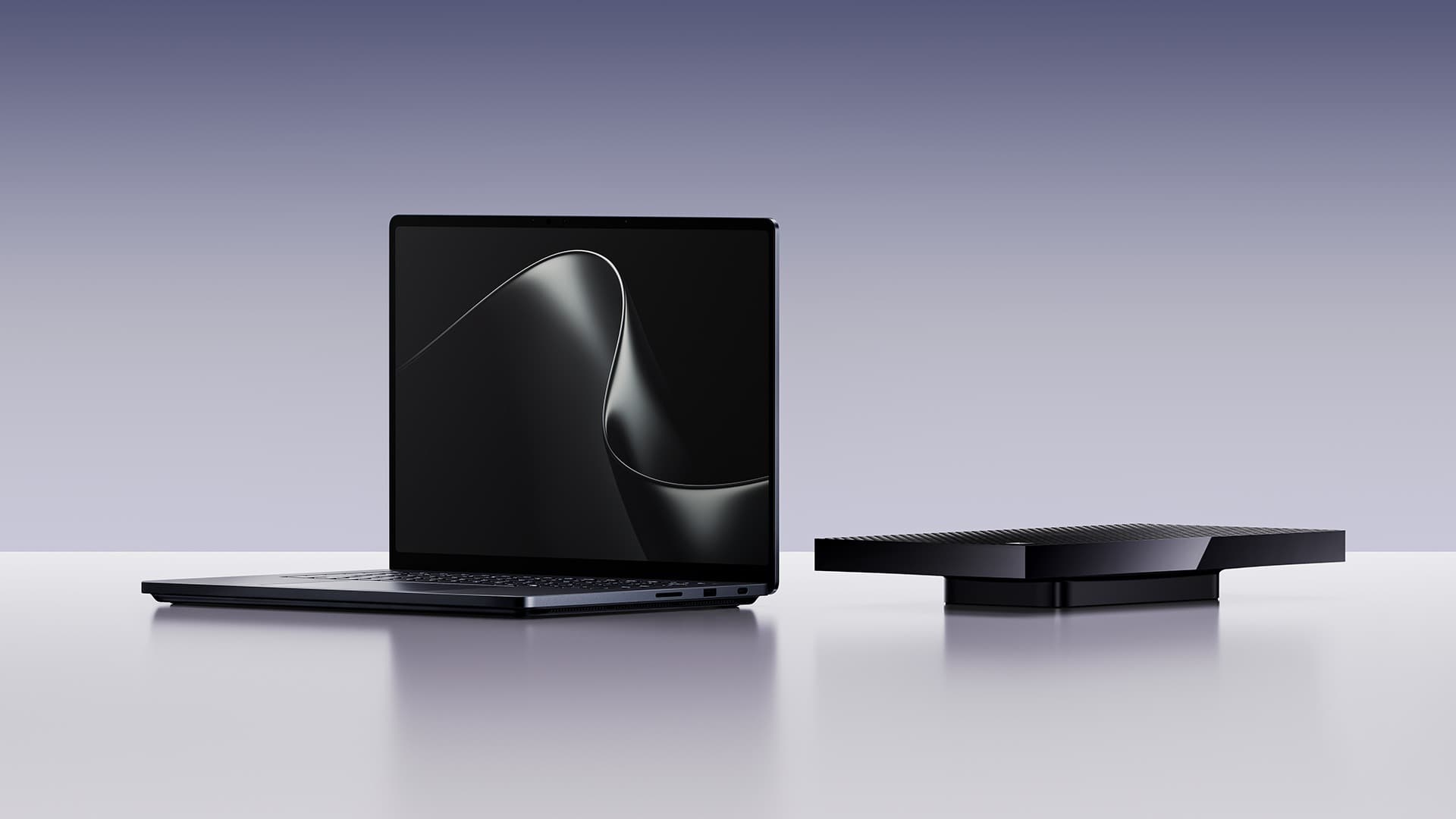
Apple's first 2nm M6 hits the Mac mini. M5 Ultra turns Studio into a $5,499 AI box
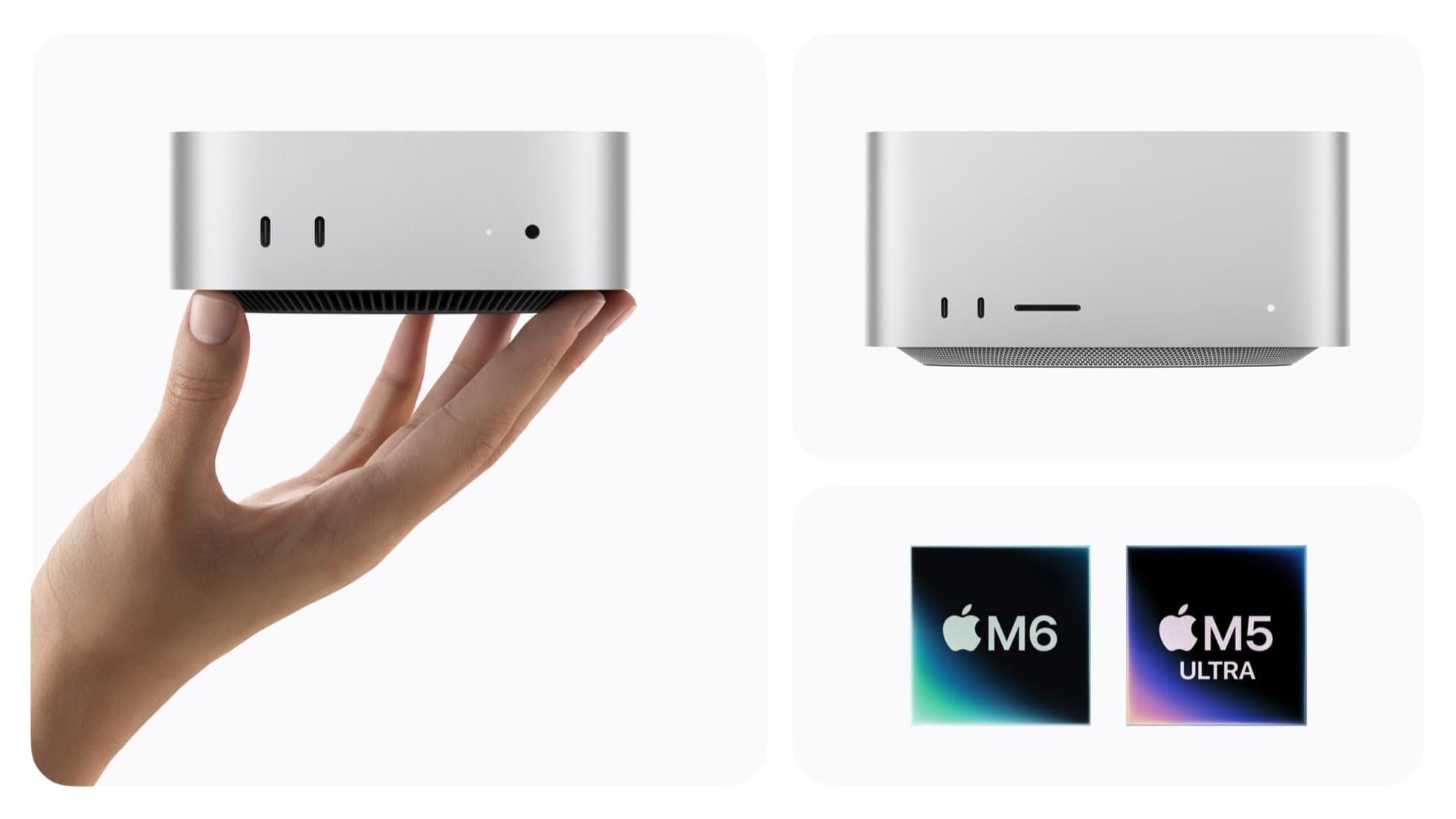
/ Mac mini with M6 starts at $899. M5 Pro is $1,699. Mac Studio with M5 Max holds $2,499, while the first quad-die M5 Ultra opens at $5,499. Same chassis, higher lists, September 22 shipping.
by Hozefa Khety
· 10 min read
Apple spent August 25 putting two new chips into two old boxes. M6 is the company's first 2-nanometer silicon, and it lands in the Mac mini. M5 Ultra is Apple's first quad-die M-series chip, and it lands in the Mac Studio. The aluminum has not changed. The price has. Pre-orders opened the same day. Machines start showing up on September 22.
The numbers Apple wants you to remember are the usual vendor multipliers. 4x AI. 2x storage. World's fastest CPU core. Treat those as marketing until independent benches land in September. The numbers that already stick are the ones on the store page. Mac mini with M6 starts at $899. Mac mini with M5 Pro starts at $1,699. Mac Studio with M5 Max starts at $2,499. Mac Studio with M5 Ultra starts at $5,499. Education is $799, $1,599, $2,299, and $5,099.
M6: 2nm, 12 cores, and a 32GB ceiling
M6 is the first Apple silicon built on a 2nm process. The CPU is a 12-core complex, two more cores than M5. Apple splits it as 2 super cores, 4 performance cores, and 6 efficiency cores. Super cores showed up with the M5 Pro and Max. Here they come down to the base chip. Apple says that layout delivers the world's fastest single-threaded performance, up to 1.2x faster multithreaded work than M5, and up to 2.4x faster than M1. Those comparisons come from Apple's August 2026 tests on a preproduction Mac mini with 32GB of memory, stacked against an M5 MacBook Pro and an M1 mini.
The GPU grew to 12 cores and puts a Neural Accelerator in each one. That is the first time those accelerators have shown up in a Mac mini. Apple claims nearly 30 percent more peak GPU compute for AI than M5, more than 8x versus M1, and a 50 percent jump in geometry rates. The Neural Engine is now Dual 16-core, which Apple says doubles peak Neural Engine compute over the previous generation. System frameworks can run both engines at once.
Memory is the part that will age worse than the clocks. M6 tops out at 32GB of unified memory and 170GB/s of bandwidth, a 10 percent bump over M5 and 2.5x over M1. 32GB is fine for Photoshop and a local 7-billion-parameter model. It is a hard stop for the people who bought the last mini to run bigger weights on the desk. If that is you, Apple is pointing at M5 Pro.
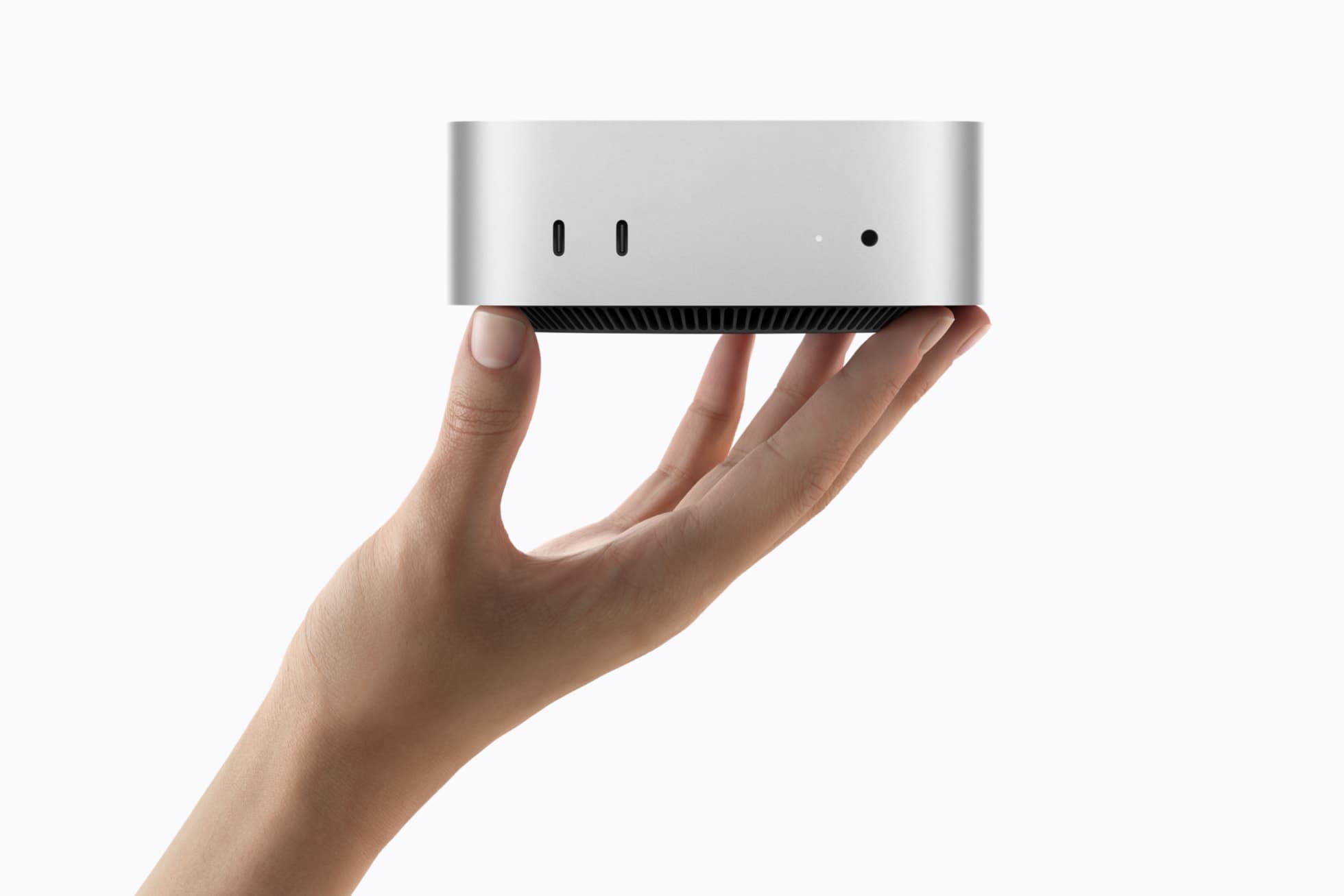
Mac mini: same 5-inch square, two chip generations in one product
Apple skipped a base M5 Mac mini last year. Today's lineup jumps the entry model to M6 and keeps M5 Pro as the step-up, the same chip already in this year's MacBook Pro. Tom's Guide put it bluntly in its launch write-up. The M5 Pro mini is the faster machine for a lot of the work Apple is selling. M6 is the new process and the new Neural Engine. M5 Pro is more cores, more memory, and Thunderbolt 5.
Base M6 configuration is 16GB of unified memory and a 256GB SSD. That storage number is the same stingy floor Apple put under the M4 mini. Engadget called it a rip-off at $899, and they are not wrong. You can configure memory to 32GB. You cannot configure it past that. Apple's own headline claims versus the M4 mini are up to 4x faster AI, 2x faster graphics, 2x faster storage, and 40 percent faster CPU. Versus M1, Apple quotes 13.5x faster LLM prompt processing in LM Studio and 2.3x faster Excel. Versus M4, those become 4.8x and 1.5x. Ray tracing in Cyberpunk 2077 Ultimate Edition is claimed 2x the M4 mini.
M5 Pro starts with a 15-core CPU, 16-core GPU, 24GB of memory, and a 512GB SSD at $1,699. Configure it up to 18 CPU cores, 20 GPU cores, and 64GB of unified memory at 307GB/s. Apple's quotes versus the M4 Pro mini are up to 4x faster LLM prompt processing in LM Studio, 1.4x faster Blender ray tracing, and 1.5x faster Affinity. Versus M2 Pro those become 8.5x, 4.5x, and 2.1x. This is the mini for people who want Studio-adjacent work without paying Studio money.
Mac mini with M6
12-core CPU, 12-core GPU, 16GB unified memory (up to 32GB), 256GB SSD, Thunderbolt 4. Education $799.
Mac mini with M5 Pro
15-core CPU and 16-core GPU at the floor, up to 18 CPU / 20 GPU cores, 24GB memory (up to 64GB), 512GB SSD, Thunderbolt 5. Education $1,599.
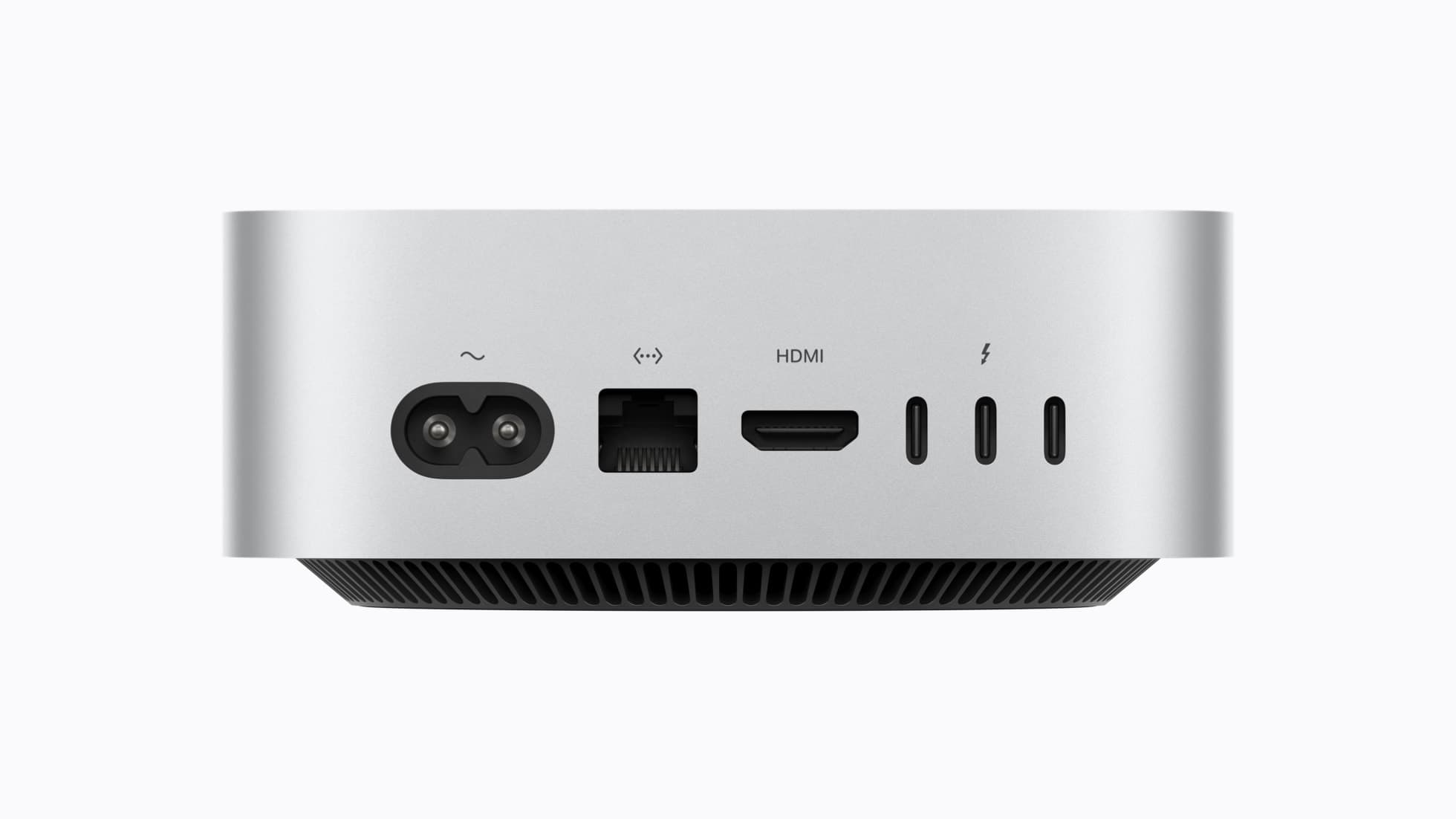
The chassis is still the 2024 cube. Front, two USB-C ports at USB 3 speeds and a high-impedance headphone jack. Back, HDMI, Ethernet, and those three Thunderbolt ports. Wireless moves to Wi-Fi 7 and Bluetooth 6 through Apple's N1 chip. Wired Ethernet is 2.5Gb as standard, 10Gb if you pay. New on both minis is genlock over USB-C, so a display and a camera can lock to the same clock. Apple name-checks iPhone 17 Pro. Thunderbolt 5 on the Pro model is also Apple's clustering story. Multiple minis can be chained to run a larger local model than one box will hold.
The Verge noted that last-gen minis got scarce because people were buying them as always-on AI boxes. Apple leaned into that. Johny Srouji's line in the press release is that the mini is a home computer, a studio machine, and an always-on agentic device. Whether $899 with 256GB of storage is the right price for that job is a different sentence.
M5 Ultra: four dies, 80 GPU cores, 1.2TB/s
Previous Ultra chips glued two Max dies together. M5 Ultra glues two dual-die M5 Max chips, which is four dies behaving as one processor. Apple's next-generation UltraFusion interconnect is quoted at over 4.4TB/s of inter-die bandwidth and more than 6x the connection density of the last UltraFusion. CPU goes up to 36 cores, 12 super and 24 performance, with no efficiency cluster. Versus M3 Ultra, Apple claims up to 1.25x single-threaded and 1.3x multithreaded performance.
The GPU is up to 80 cores with a Neural Accelerator in each core, the first time those accelerators have reached an Ultra chip. Apple's AI compute claim is the loud one. Up to 4.5x the peak GPU compute for AI versus M3 Ultra, over 6x versus M1 Ultra. Graphics are more modest, up to 40 percent faster than M3 Ultra, with second-generation Dynamic Caching, hardware mesh shading, and third-generation ray tracing. Unified memory goes to 512GB at 1.2TB/s, 50 percent more bandwidth than M3 Ultra. Neural Engine is 32-core. The Media Engine doubles M5 Max's encode and decode blocks. Apple's demo number is 33 simultaneous streams of 8K ProRes 422 at 30 fps.
Gizmodo's launch take is that this chip is for Pixar, not a typical creative. That is the right frame. 512GB of unified memory in a memory crunch is a product for people who already know they need it. Apple says that ceiling lets you keep huge datasets in local memory and run LLMs with hundreds of billions of parameters on the desk. The 512GB configuration does not ship until late October, and Apple has not posted a price for it yet.
Mac Studio: M5 Max at $2,499, M5 Ultra at $5,499
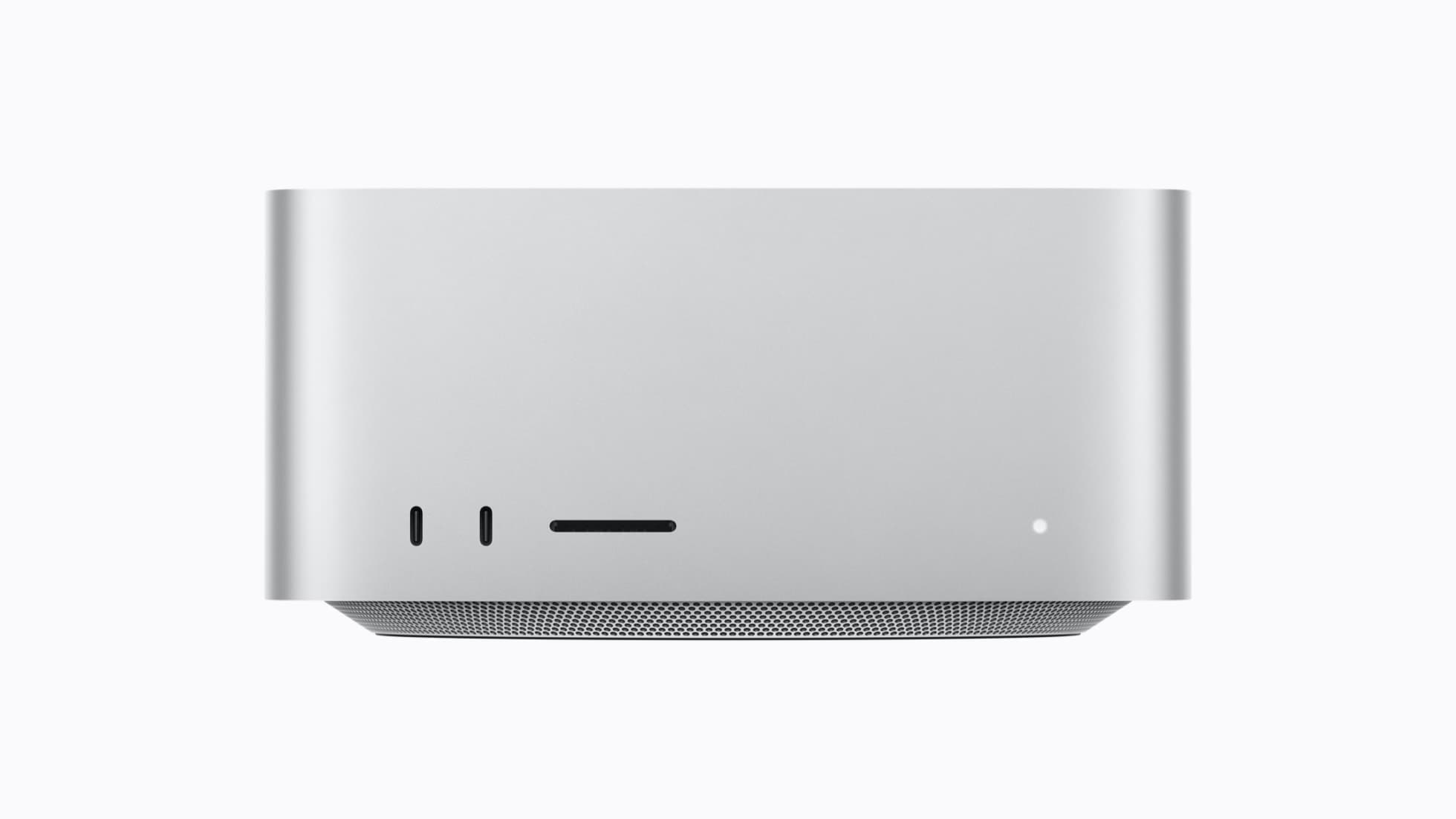
The last Studio generation was an awkward split. M4 Max in the cheaper machine, M3 Ultra in the faster one, because there was never an M4 Ultra. This refresh puts both SKUs on M5 silicon. The Verge noted the boxes look identical to every Studio since 2022, USB-A ports on the rear included.
M5 Max in the Studio is an 18-core CPU with 6 super cores and 12 performance cores, an up-to-40-core GPU, up to 128GB of unified memory, and up to 614GB/s of bandwidth. Base config is 36GB of memory and a 512GB SSD at $2,499, matching the post-June price of the outgoing M4 Max Studio. Apple claims the GPU is up to 50 percent faster than the previous generation. Versus M4 Max, the company quotes 3.9x faster LLM prompt processing in LM Studio, 3.5x faster text-to-image, 3x faster Magic Mask in DaVinci Resolve Studio, and 1.9x faster DNA basecalling in Oxford Nanopore MinKNOW. Versus M1 Max those become 10.7x, 7.4x, 5.3x, and 3.5x.
M5 Ultra starts at $5,499 with a 96GB / 1TB configuration. The Verge flagged that as only $200 above the outgoing M3 Ultra's last starting price, and a much longer walk from the $3,999 that M3 Ultra launched at. Apple's Ultra-versus-Ultra quotes include 4.3x the peak AI compute of M3 Ultra, 4x faster LLM prompt processing, 4.3x faster text-to-image, 3.3x faster CopyCat ML training in Foundry Nuke, and 1.7x faster Maxon Redshift. Versus M1 Ultra the same tests are 9.8x, 9.8x, 8.2x, 15.4x, and 4.7x. Graphics overall are claimed up to 1.8x the prior generation.
Mac Studio with M5 Max
18-core CPU, up to 40-core GPU, 36GB unified memory (up to 128GB), 512GB SSD, up to 614GB/s. Education $2,299.
Mac Studio with M5 Ultra
Up to 36-core CPU, up to 80-core GPU, 96GB unified memory (up to 512GB in late October), 1TB SSD, 1.2TB/s. Education $5,099.
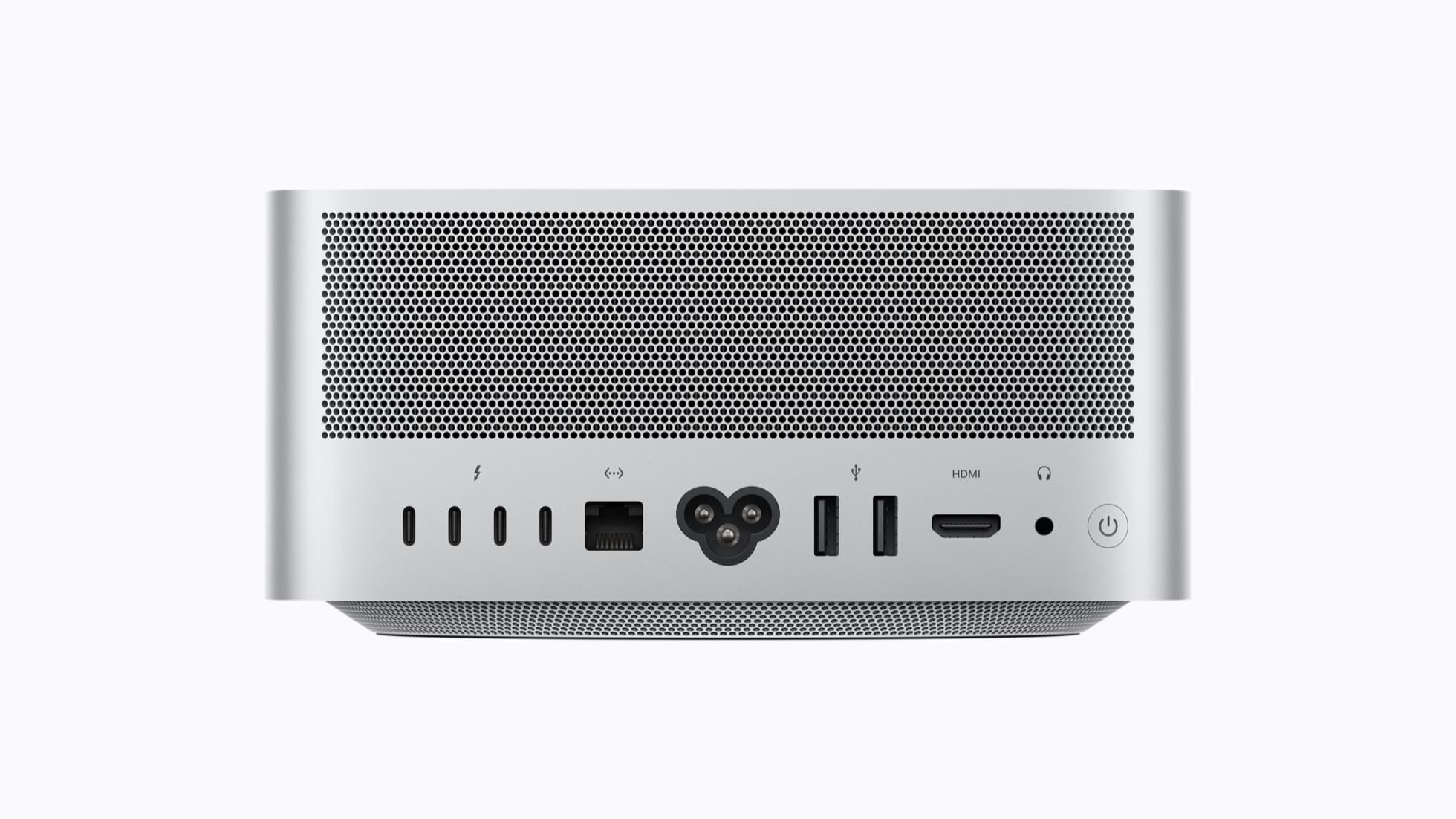
Storage on the new Studio uses a PCIe Gen 6 SSD architecture. Apple claims up to twice the read and write of the previous generation, which matters more for loading a 70-billion-parameter model than for opening Mail. Wireless finally catches up. The N1 chip brings Wi-Fi 7 and Bluetooth 6 to Studio for the first time. Thunderbolt 5 is quoted at 120Gb/s. Apple's clustering pitch is more specific here than on the mini. Thunderbolt 5 plus RDMA lets multiple Studios share a memory pool. Four machines are claimed up to 3x faster at distributed AI inference than one.
Display support is up to eight monitors, or four Studio Display XDR units at full 5K and 120Hz. Genlock over USB-C is here too. The software stack Apple wants on these desks is macOS 27 Golden Gate, Siri AI, a new Core AI framework, MLX, and Xcode. Siri AI is in beta with macOS 27 later this year, English first.
What the price sheet actually says
The Verge clocked both new minis at $100 above the most recent M4 starting prices. After June's mid-cycle hike, that was $799 for the base mini and $1,599 for M4 Pro. Go back to the M4 mini's original $599 launch and Engadget's $300 gap is the one that hurts. The Studio M5 Max holds at $2,499, the same as the hiked M4 Max. Ultra is the only Studio that moved, $200 above the last M3 Ultra list.
Apple did not hide the memory story. It also did not give the base mini 512GB of storage, which is the cheapest goodwill it could have bought. The people who turned the last mini into an AI appliance are being asked to pay more for a faster chip that still maxes out at 32GB. The M5 Pro mini at $1,699 is where local models start to fit. Studio is where the question flips from whether a model runs to how fast.
Should you buy one?
If you are on M1 or M2, yes, with the usual caveat that Apple's multiples are Apple's multiples. A 2nm 12-core M6 in the same tiny chassis is a real generational jump for compile times, local agents, and anything single-threaded. If you are on M4, sit. The Verge and Engadget both landed there on day one. Forty percent CPU and 2x graphics are not nothing, but they are not $899 of nothing when you already own the cube.
M5 Pro mini is the interesting SKU if you need 64GB and Thunderbolt 5 and you do not want a Studio under the desk. M5 Max Studio is the quiet default for working editors and developers who already live in Resolve, Xcode, and Redshift. M5 Ultra is a specialist part. 80 GPU cores and a 512GB option exist because Apple killed the Mac Pro and this is what is left at the top of the stack.
Independent reviews do not exist yet. Apple tested preproduction machines in July and August. Wait for September units if you can. If you cannot, the honest buy is the chip that matches the memory your workload actually needs, not the one with the newer process number on the slide.
Frequently asked questions
What is the Apple M6 chip?
M6 is Apple's first 2-nanometer Mac chip, announced August 25, 2026. It has a 12-core CPU (2 super, 4 performance, 6 efficiency), a 12-core GPU with Neural Accelerators in each core, a Dual 16-core Neural Engine, up to 32GB of unified memory, and up to 170GB/s of memory bandwidth. It ships first in the new Mac mini.
What is the Apple M5 Ultra chip?
M5 Ultra is Apple's most powerful M-series chip, built by connecting two dual-die M5 Max chips with next-generation UltraFusion. It is Apple's first quad-die M-series SoC, with up to a 36-core CPU, an 80-core GPU with Neural Accelerators, a 32-core Neural Engine, up to 512GB of unified memory, and 1.2TB/s of memory bandwidth. It is exclusive to Mac Studio.
How much does the new Mac mini cost?
In the US, Mac mini with M6 starts at $899 ($799 education) with 16GB of memory and a 256GB SSD. Mac mini with M5 Pro starts at $1,699 ($1,599 education) with 24GB of memory and a 512GB SSD. Pre-orders opened August 25, 2026. Units begin arriving September 22.
How much does the new Mac Studio cost?
In the US, Mac Studio with M5 Max starts at $2,499 ($2,299 education) with 36GB of memory and a 512GB SSD. Mac Studio with M5 Ultra starts at $5,499 ($5,099 education) with 96GB of memory and a 1TB SSD. The 512GB unified memory configuration is due in late October. Pre-orders opened August 25, with September 22 availability for standard configs.
M6 vs M5 Pro Mac mini. Which is faster?
M6 is the newer 2nm chip with better single-thread claims and a Dual 16-core Neural Engine, but it maxes out at 32GB of memory and Thunderbolt 4. M5 Pro has more CPU and GPU cores, 64GB of memory, 307GB/s of bandwidth, and Thunderbolt 5. For heavier local models, 3D, and video, M5 Pro is the faster machine. M6 is the better everyday chip if 32GB is enough.
Does the Mac mini still start with 256GB of storage?
Yes. The M6 Mac mini still ships with a 256GB SSD at the $899 floor. The M5 Pro mini starts at 512GB. Apple claims storage is up to twice as fast as the previous generation.
Can you cluster Mac minis or Mac Studios for AI?
Apple says Thunderbolt 5 lets you cluster multiple Mac mini (M5 Pro) or Mac Studio systems to run larger models on device. On Studio, Thunderbolt 5 plus RDMA can share memory across machines. A cluster of four Studios is claimed up to 3x faster at distributed AI inference than a single system.
When do the new Mac mini and Mac Studio ship?
Pre-orders started August 25, 2026. Apple says units begin arriving to customers, Apple Stores, and authorized resellers on September 22. Mac Studio with 512GB of unified memory is scheduled for late October.