Apple raises Mac and iPad prices as the global memory crunch finally lands
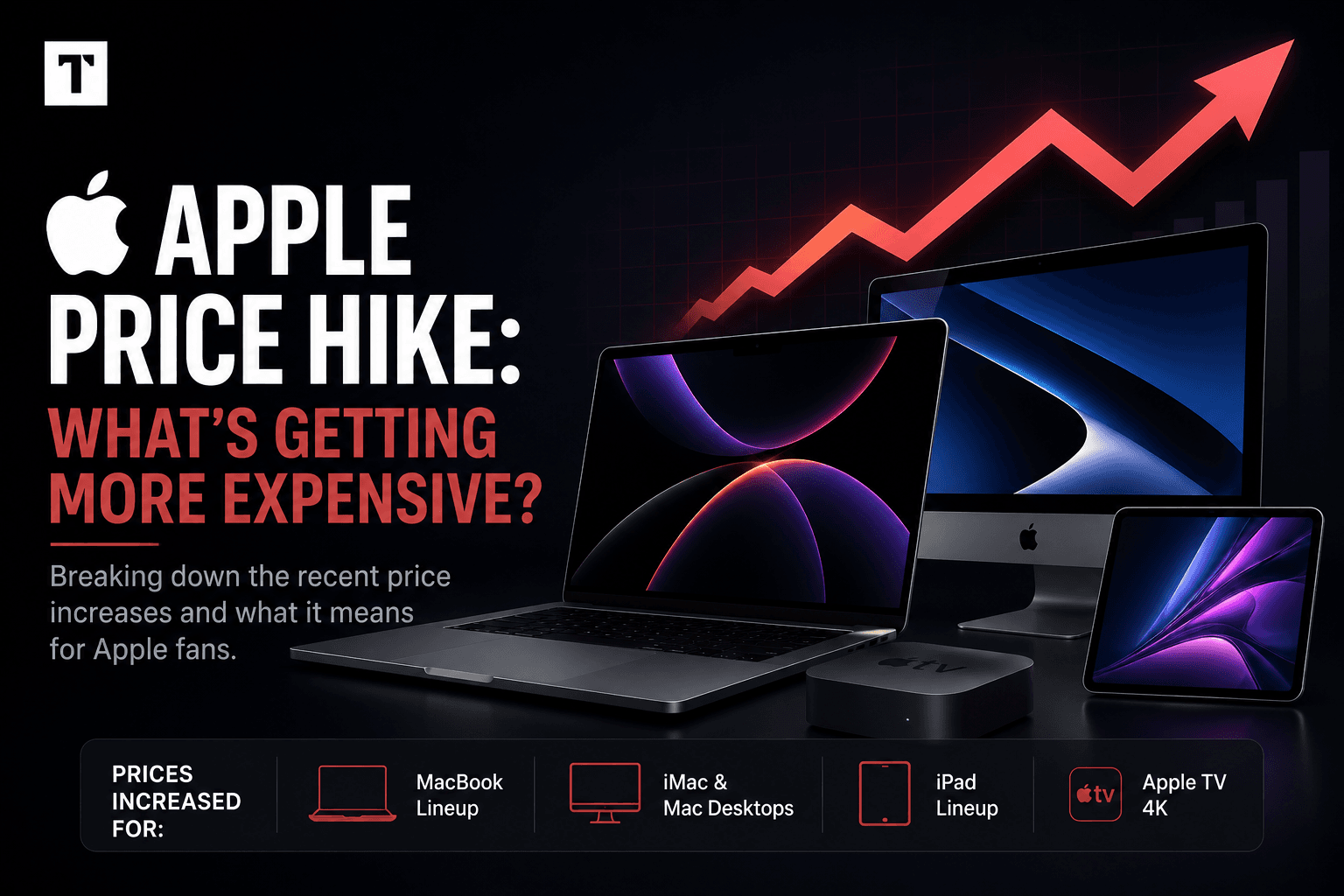
/ Mid-cycle hikes hit MacBook Neo, Air, Pro, iPads, HomePod, and Vision Pro while iPhones hold steady — with Indian buyers facing steeper increases and a new currency conversion formula.
by Hozefa Khety
· 6 min read
Apple raised prices on June 25 across nearly every major product line that is not an iPhone — Macs, iPads, HomePods, Apple TV, and even the Vision Pro — in one of the broadest mid-cycle pricing moves the company has made in years. The MacBook Neo's headline $599 entry point is now $699. The base MacBook Air climbed from $1,099 to $1,299. The 14-inch MacBook Pro starts at $1,999 instead of $1,699. Desktop buyers face similar jumps: the Mac Studio now opens at $2,499, up from $1,999. iPads moved in step — the standard model from $349 to $449, the Air from $599 to $749, the Pro from $999 to $1,199, and the iPad mini from $499 to $599.
For a company that rarely adjusts list prices between product generations, the scale of the change is the story. Apple does not run seasonal sales on current hardware. Walk into an Apple Store in March or August and the numbers on the shelf are usually identical. When those numbers shift on existing SKUs, it signals that something upstream in the supply chain has broken the usual math — and in 2026, that something is memory.
Why Apple moved now — and what the company said
In a statement to CNBC, Apple described an "unprecedented challenge" facing consumer electronics: rapid AI data-center expansion has created an extraordinary surge in demand for memory and storage. "We have never seen a component price increase this much, this quickly," the company said, adding that it is "working tirelessly to find solutions" while acknowledging the news is unwelcome. The framing matches what CEO Tim Cook told The Wall Street Journal days earlier — that price increases were becoming unavoidable as DRAM and NAND costs climbed.
Research firm Counterpoint told TechCrunch that smartphone DRAM prices jumped roughly 50% and NAND flash storage rose more than 90% quarter-over-quarter in Q1 2026, with memory costs up more than fourfold since Q4 2025. At that level, absorbing hikes inside existing margins stops being a strategy and becomes a choice to sell hardware at a loss. Apple held the line longer than most rivals thanks to volume purchasing and historically generous margins, which is why industry watchers treat this week's adjustments as a bellwether: if Apple could not eat the increase, smaller OEMs were never going to.
The full US price sheet — Mac, iPad, and the rest
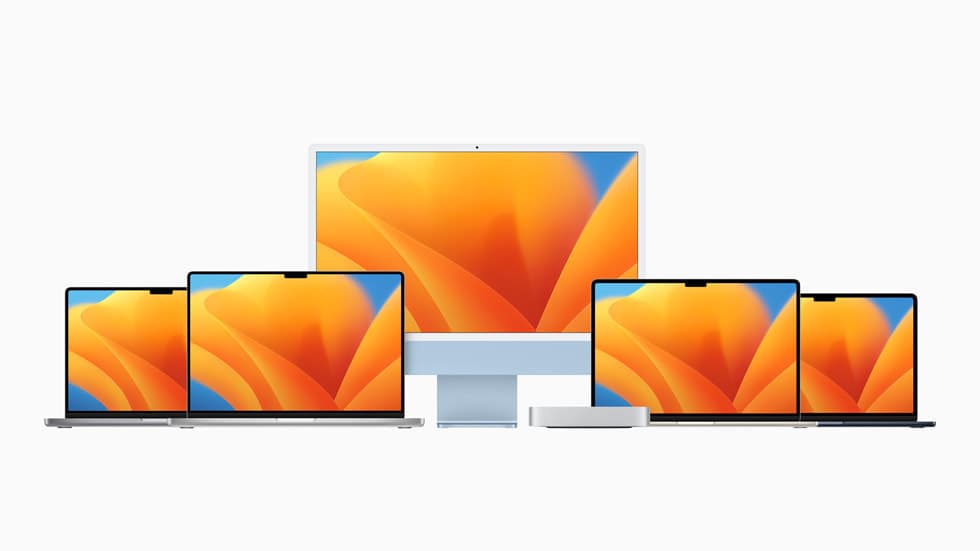
Beyond the laptops, the M4 Pro Mac mini now starts at $1,599, up from $1,399 — a notable move given Apple had reshuffled the mini lineup in May, discontinuing the $599 256GB base and elevating a 512GB model to entry status. Smart home hardware was not spared: HomePod rose from $299 to $349, HomePod mini from $99 to $129, and Apple TV 4K from $99 to $129. The Vision Pro, already among the most expensive devices Apple sells, climbed from $3,499 to $3,699.
iPhones were left off the list for now. That is not necessarily permanent. Cook has pointed to constraints on application processors rather than memory for phones, and multiple outlets expect the iPhone 18 family — likely arriving in autumn — to open at higher tiers if component costs do not ease. For shoppers who were waiting for a Mac or iPad, the practical takeaway is blunt: yesterday's configuration is today's more expensive configuration, with no new features attached.
India gets hit harder than the US
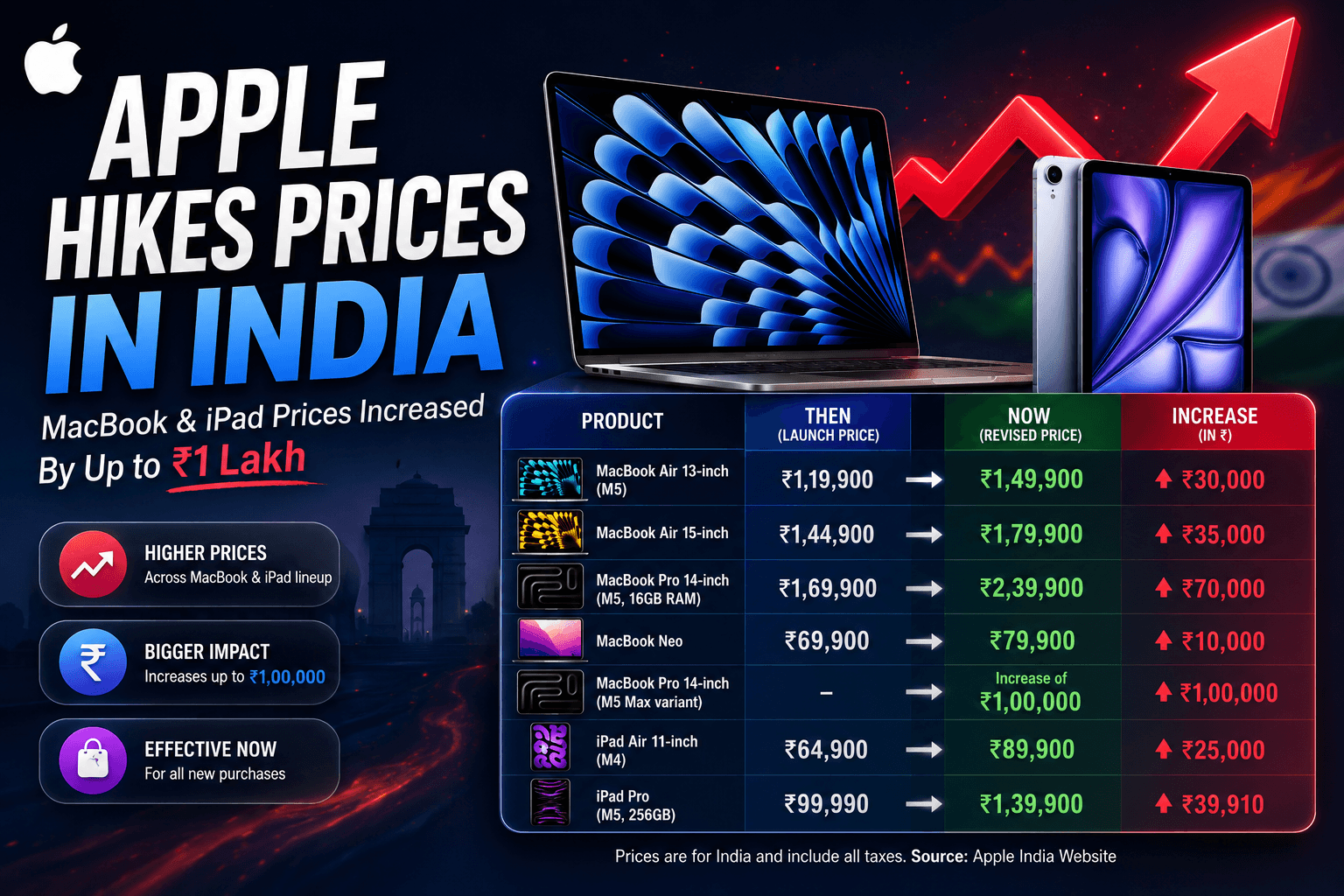
Global does not mean uniform. Reporting from GSMArena shows Indian increases outpacing American ones on several models. The MacBook Neo moved from ₹69,900 to ₹79,900 — about a 14% rise — while the MacBook Air 13 jumped 25%, the 14-inch MacBook Pro 26%, and the iMac nearly 30%. The M4 Mac mini tells an especially sharp story: after Apple briefly made 512GB the base storage tier, the 256GB model returned as the starting configuration, yet at ₹94,900 versus a previous ₹59,900 — a roughly 58% increase on an apples-to-apples comparison.
iPads in India saw hikes in the high thirties to low forties percent range. Apple TV 4K configurations reportedly approached double their prior pricing in some trims. Two compounding factors explain why the pain is worse south of the component shortage alone. First, Apple India raised the surcharge for memory and storage upgrades — historically billed in ₹20,000 steps, now often ₹24,000 or ₹30,000 depending on capacity. Second, the company appears to have abandoned its long-standing rough parity of ₹100 per US dollar on list prices. A $699 Neo mapping to about ₹79,900 instead of ₹69,990 means even a future easing of DRAM spot prices may not fully restore old Indian MSRPs.
Apple is late to a party the rest of tech already attended
Console makers blamed memory costs when raising PlayStation, Xbox, Switch, and Steam Deck prices. Samsung's Galaxy S26 line arrived with less storage at higher prices than its predecessors. Google's Pixel 10a largely recycled the 9a while its selling point became "it did not get more expensive." Valve priced its Steam Machine at roughly twice a PlayStation 5. The through-line is not Apple-specific incompetence; it is a supply chain tilted toward AI accelerators and the high-bandwidth memory feeding them.
Apple's timing nonetheless matters symbolically. The Verge described the company as a "reverse canary in the coal mine" — when Apple raises prices on current hardware, the shortage is no longer a rumor on earnings calls. Micron, one of the major memory suppliers, reported a roughly fourfold year-over-year revenue jump in its latest quarter, which is what demand shock looks like from the supplier side. Consumer OEMs are left competing for scraps of a fab output calendar increasingly booked by hyperscalers.
What buyers should do — and what to watch next
If you need a Mac or iPad soon, third-party retailers may still have pre-hike inventory at older prices, though that window closes quickly. Refurbished units from Apple and authorized resellers become comparatively more attractive when list prices jump without spec bumps. Waiting for a holiday discount from Apple itself is historically futile; the company does not discount current-generation hardware in its own channels.
The longer arc depends on when memory supply catches up to AI buildouts. Cook has suggested several months before Mac Studio and Mac mini supply normalizes. Counterpoint expects other PC and tablet vendors to follow with selective increases, smaller storage tiers, or fewer promotional discounts rather than absorbing costs indefinitely. For anyone building a 2026 gadget budget, treat memory like energy in the 1970s: a hidden tax on every device with silicon inside — and now, finally, on Apple's price tags too.
Frequently asked questions
Which Apple products got price increases in June 2026?
Apple raised US list prices on Macs (including MacBook Neo, Air, Pro, mini, Studio, and iMac), all current iPad models, HomePod and HomePod mini, Apple TV 4K, and Vision Pro. iPhone prices were unchanged in this round.
Why did Apple raise prices?
Apple cited an industry-wide memory and storage shortage driven by AI data-center demand. DRAM and NAND costs rose sharply in early 2026, making it difficult to hold existing prices without eroding margins.
How much did MacBook prices increase?
In the US, the MacBook Neo rose from $599 to $699, the base MacBook Air from $1,099 to $1,299, and the 14-inch MacBook Pro from $1,699 to $1,999. India saw larger percentage increases on several models.
Did iPhone prices go up?
Not in this June 2026 adjustment. Analysts and commentators expect potential increases when the iPhone 18 line launches later in 2026 if memory costs remain elevated.
Are Apple price hikes higher in India than the US?
Yes. Reporting shows steeper percentage increases in India on many Mac and iPad models, plus higher surcharges for RAM and storage upgrades and a revised currency conversion approach that pushes Indian MSRPs above the old ~₹100-per-dollar mapping.