Tesla FSD v15: release date, features and which cars get it
/ Tesla FSD v15 is rolling out to early testers, with wide release due in December. What's new in Reality View, which Teslas get it, the cost and what's unproven.
by Hozefa Khety
· 6 min read
Tesla has started rolling out Full Self-Driving (Supervised) v15, the biggest update to its driver-assistance software in more than a year. Tesla announced the rollout on X on Saturday, November 21, 2026, and Elon Musk says it goes to wide release next month. The headline features are a new, far more realistic on-screen view of the road called Tesla Reality View, a claimed 25x improvement in how often the system needs a critical takeover, and better handling of potholes, debris, road signs and school zones. Details below were checked against Tesla's posts and release notes at 03:00 IST on November 23 (21:30 UTC, November 22).
Here is when you can get it, which cars qualify, what is new, what it costs and what Tesla has not said yet.
When is FSD v15 coming out?
The first build, FSD v15.0.1 in software update 2026.38.6.11, is going to members of Tesla's Early Access Program first, a small group of owners who test new versions before everyone else, according to Teslarati and Tesla Oracle. Musk wrote on November 21: "FSD V15 goes to wide release next month. It will be something special." When an owner asked whether it would arrive with Tesla's annual holiday software update, Musk reportedly replied "Yeah", according to TeslaNorth.
So December 2026 is the target for most owners in the US, but Tesla has not given an exact date, and past FSD versions have often taken longer than Musk's timelines. Tesla has not said when v15 reaches other countries.
Which Teslas get FSD v15?
FSD v15 needs Tesla's newer AI4 computer, also called Hardware 4 or HW4. Tesla's release notes list only that hardware, and Not a Tesla App has reported that Tesla confirmed there will be no "v15 Lite" for older cars. Most Model S and Model X built from 2023, most Model Y built from mid-2023, the refreshed Model 3 and every Cybertruck have AI4, but build dates overlap, so check your car rather than going by model year.
To check, tap Software on the touchscreen and look at the Autopilot computer line under Additional Vehicle Information. AI4 means your car can get v15. If it says Full Self-Driving Computer, you have the older HW3 computer.
HW3 cars stay on a separate, slimmed-down branch called FSD v14 Lite. Musk said in April 2026 that HW3 cannot handle unsupervised driving and talked about an upgrade path and trade-in discounts for owners who paid for FSD, but Tesla still has not published a date or price for a computer retrofit.
What is Tesla Reality View?
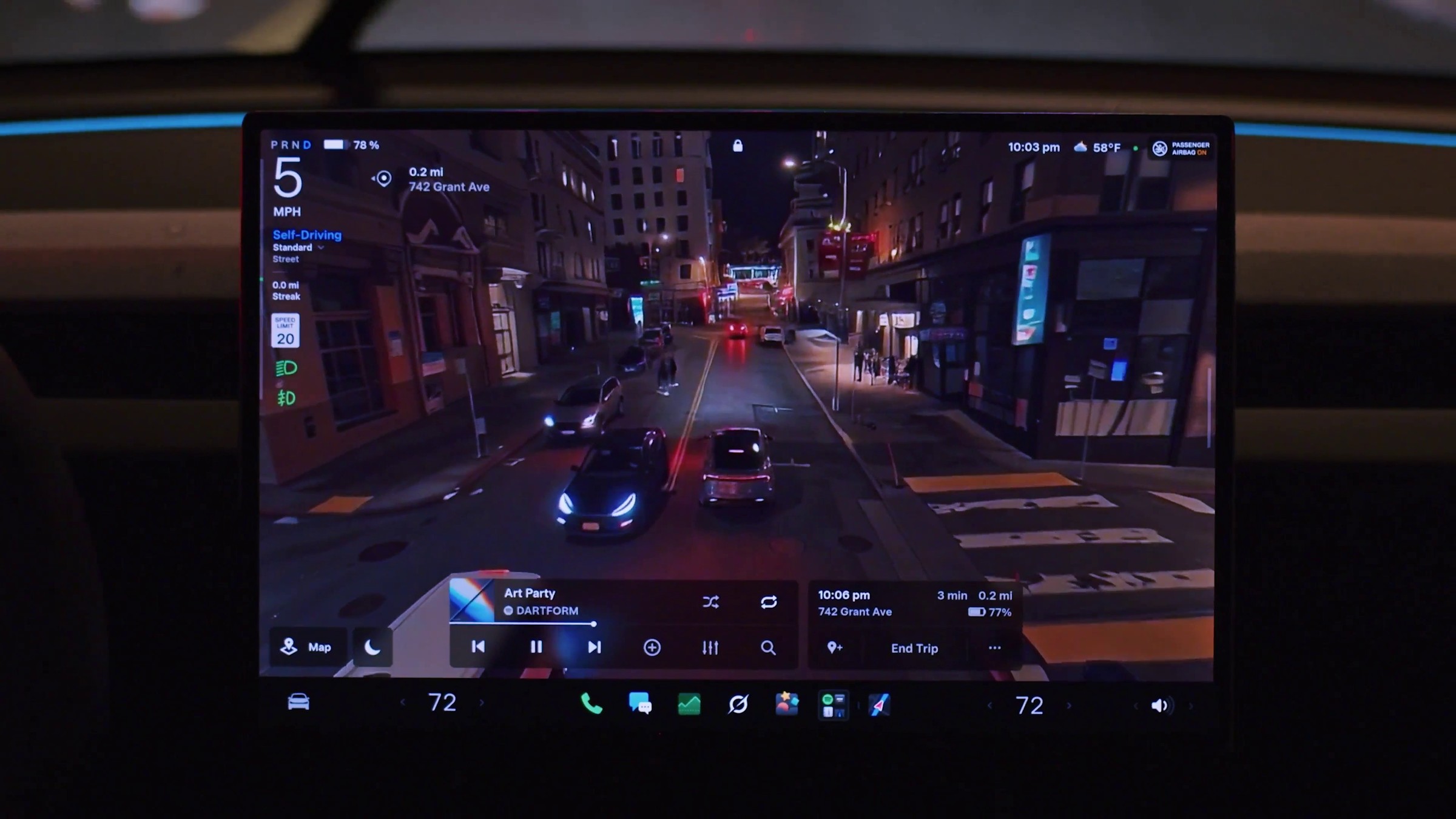
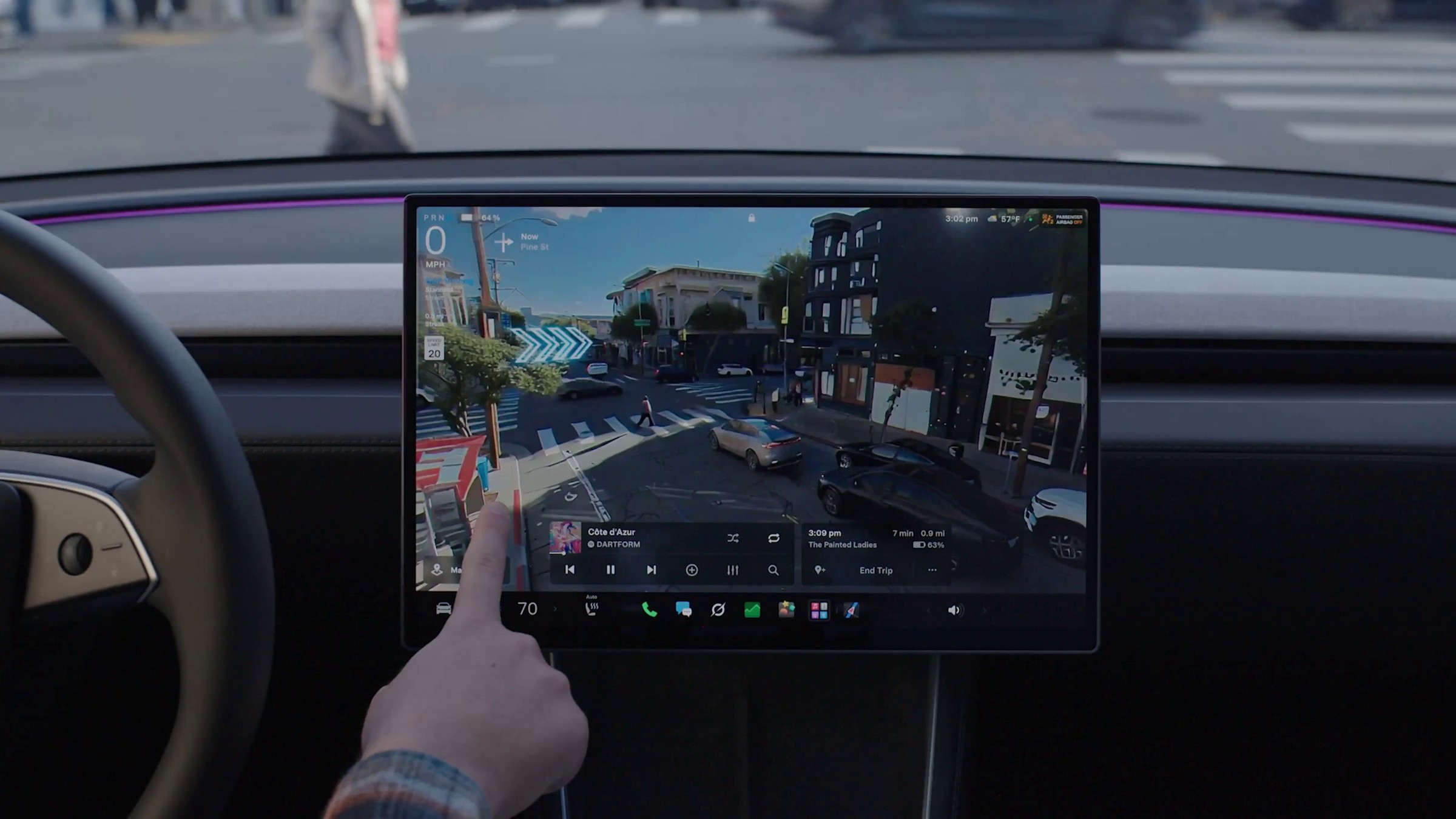
Reality View replaces the blocky, video-game-style cars and lane lines that Tesla screens have shown for years. Tesla describes it as a real-time generative driving visualization: the car's computer redraws the street around you, with buildings, parked cars, pedestrians and road markings, as if seen from a virtual camera above and behind the car. Upcoming navigation turns appear directly in that view.
You can switch between a full-screen visualization, the map, or a split view, or choose a quiet mode for a calmer cabin. Musk said you can tap any point in the view to make the car go there, and that turns are shown with chevrons in the sky "like a video game". Tesla's official release notes call it Tesla Reality View, though an earlier version of the notes quoted by Electrek and Teslarati used the name Tesla Augmented Reality.
What else is new in FSD v15?
Tesla says v15 "upgrades every part of the end-to-end driving network", meaning the single AI model that turns camera video into steering, braking and acceleration. The main changes in Tesla's release notes are:
A new vision encoder, the part of the AI that makes sense of camera images, shared with Tesla's Robotaxi service and its Optimus robot. Tesla says it was trained on millions of internet videos and improves the critical intervention rate by 25x.
Better detection of road signs, small animals, road debris and chains, plus potholes and deep standing water, which the car should now avoid.
More natural speed in school zones, around speed limits and in bad weather, adjusted for each driver profile.
Smarter navigation for the start and end of a trip, learned from the routes other Tesla drivers prefer. Tesla says later v15 releases will extend this to the whole route. Parking spot choice now uses your own parking history, and the map can show several parking options at your destination.
Driver monitoring that works more often when you wear a hat or sunglasses, and is less strict in the faster driver profiles. Autoshift, which picks drive or reverse for you, now uses FSD's own predictions.
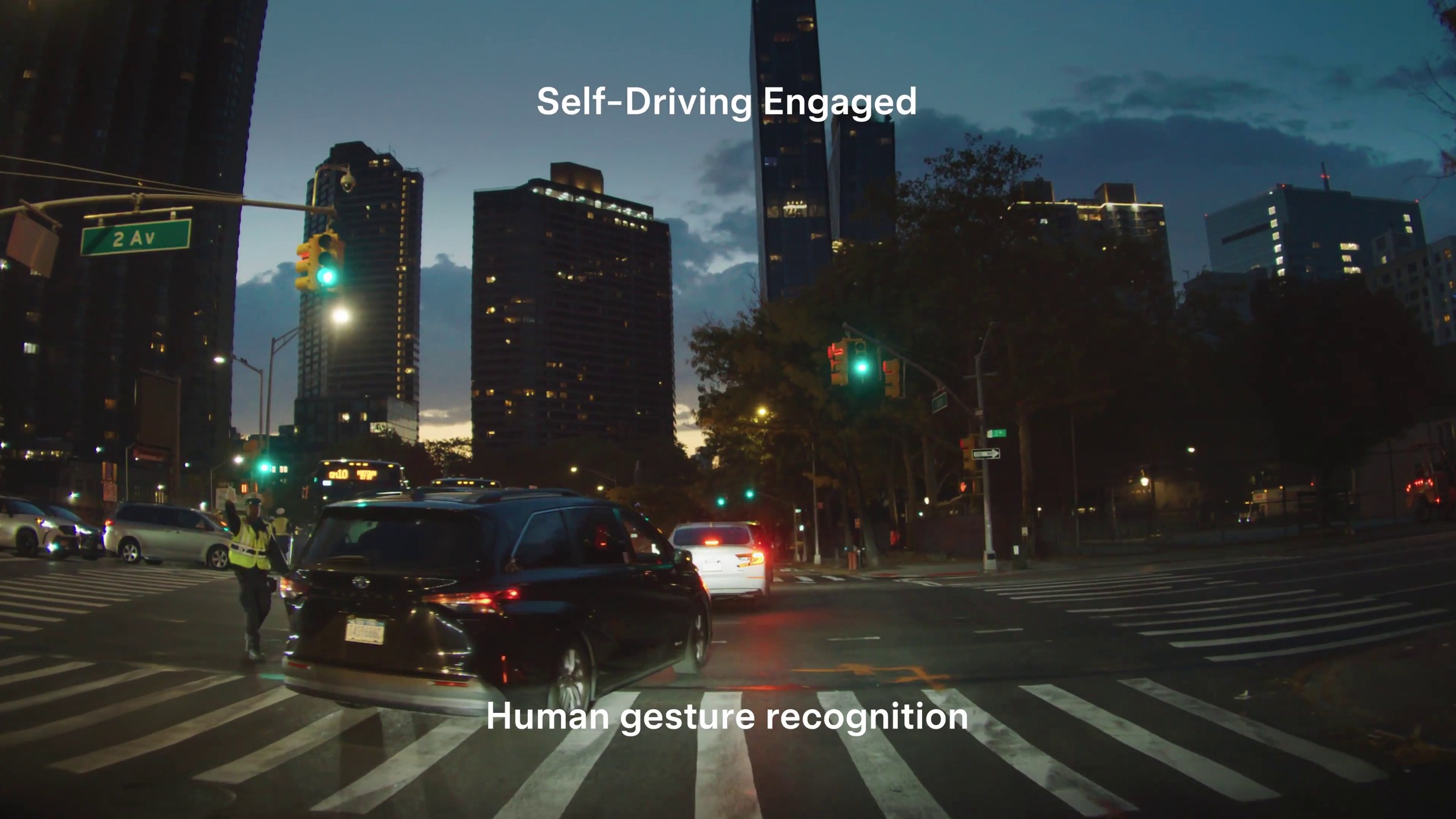
Tesla's launch video also lists human gesture recognition, such as following a traffic officer's hand signals, and claims v15 is "9x safer than a human", but Tesla has not published data behind that figure.
Speed camera slowdown and Bike Rack Mode
FSD can now slow down when it spots a speed camera. To cancel the slowdown, press the accelerator or raise your speed profile. If you cancel twice at the same camera, the car saves that location and stops slowing there. You can clear saved cameras in Controls, Service, Manage Saved Locations.
Bike Rack Mode lets you use FSD and Autosteer with a bike rack or similar hitch accessory fitted. With it switched on, FSD pulls over near your destination instead of reversing into a spot, and Autopark, Summon and the backup chimes and warnings are turned off.
How much does FSD v15 cost?
There is no separate charge for v15. It comes as a free software update to cars that already have FSD (Supervised). In the US, Tesla lists FSD (Supervised) at $99 a month, cancel any time, and it is subscription-only: Tesla stopped selling FSD as a one-time purchase on February 14, 2026, when the upfront price was $8,000. Owners who bought FSD outright before then keep it.
Tesla's support page lists monthly FSD subscriptions in the US, Canada, Mexico, Puerto Rico, Australia, New Zealand and 11 European countries, including the Netherlands, Belgium, Denmark and Finland. Being in one of those markets does not mean you get v15 in December, since Tesla has only talked about the US rollout so far.
Is FSD v15 self-driving?
No. Despite the name, it is still FSD (Supervised), a driver-assistance system. You must keep watching the road and be ready to take over at all times, and you remain responsible for the car. Tesla runs unsupervised versions of its software in its own Robotaxi fleet, but owner cars on v15 are not unsupervised.
What Tesla hasn't said about FSD v15
The 25x figure is a multiplier with no starting number. Tesla's release notes say it refers to the critical intervention rate, how often a driver has to step in to avoid a problem, but Tesla does not publish that rate. Electrek, which tracks crowdsourced data, noted that if v14 managed a couple of thousand miles between critical interventions, a real 25x gain would be a major step toward unsupervised driving, but there is no independent data yet.
Electrek also pointed out that the update targets FSD's best-known weak spots. A Brussels test published in September by the nonprofit Johanna.be found FSD exceeded the limit in 55% of the 30 km/h zones it drove through, and the US safety regulator NHTSA opened an investigation in October 2025 into FSD traffic-law violations such as running red lights. Easing driver monitoring in faster profiles also cuts against the tighter monitoring regulators have asked for in Europe.
Past major releases, including v14 in October 2025, arrived with new bugs alongside real gains, and early point releases sometimes went backward. The first real-world verdicts will come from Early Access owners over the next few weeks.
Images: frames from Tesla's official FSD v15 announcement video posted on X on November 21, 2026 (Image: Tesla).
See more of The Threshold on Google
Add us as a preferred source to see more of our stories in your Top Stories.
Frequently asked questions
When is FSD v15 coming out?
Tesla started rolling out FSD v15.0.1 to Early Access Program owners on November 21, 2026. Elon Musk says the wide release follows in December 2026, reportedly with Tesla's holiday update, but Tesla has not given an exact date.
Will my Tesla get FSD v15?
Only if it has the AI4 (Hardware 4) computer. Check Software, then Additional Vehicle Information, on the touchscreen: AI4 cars qualify. Older HW3 cars stay on the separate FSD v14 Lite branch, and Tesla has said there will be no v15 Lite.
How much does FSD v15 cost?
The v15 update itself is free for cars that already have FSD (Supervised). In the US, FSD (Supervised) costs $99 a month as a subscription; Tesla stopped selling it outright on February 14, 2026.
What is Tesla Reality View?
Reality View is FSD v15's new on-screen visualization. The car's computer redraws the street around you in realistic detail from a virtual camera above the car, shows upcoming turns in the view and, per Elon Musk, lets you tap a point to send the car there.
Is FSD v15 fully self-driving?
No. It is FSD (Supervised), a driver-assistance system. The driver must watch the road, be ready to take over at all times and remains responsible for the car.
What does 25x safer mean for FSD v15?
Tesla says its new vision encoder improves the critical intervention rate, how often a driver must take over to avoid a problem, by 25x. Tesla has not published the underlying rate, so the claim cannot be independently checked yet.
Can FSD v15 slow down for speed cameras?
Yes. FSD v15 can slow down when it detects a speed camera. Press the accelerator or raise your speed profile to cancel; cancel twice at the same camera and the car stops slowing there. Saved cameras can be removed in Controls, Service, Manage Saved Locations.
When will FSD v15 come to Europe, Canada or Australia?
Tesla has not said. FSD subscriptions are sold in Canada, Mexico, Australia, New Zealand and 11 European countries, but Tesla and Musk have only discussed the US rollout of v15 so far.