Snapdragon 8 Elite Gen 6 Pro Specs (2026): LPDDR6, Adreno 850, vs Competition
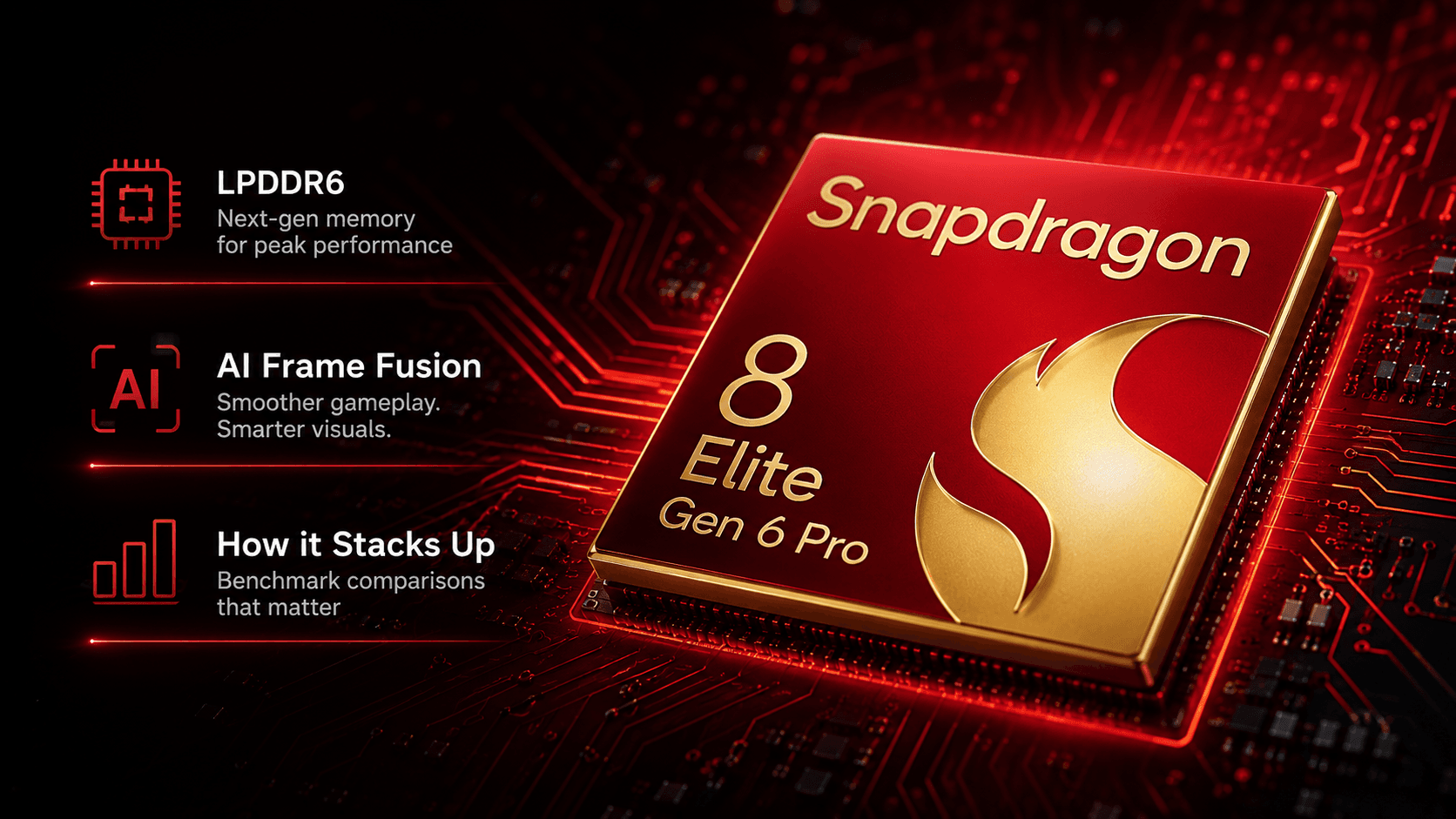
/ Snapdragon 8 Elite Gen 6 Pro (SM8975) specs leak ahead of Summit Sept 22–24: TSMC N2P, Adreno 850, AI Frame Fusion, Android's first LPDDR6 option — plus Gen 6 Pro vs Gen 6, Dimensity 9600, Apple A20, and Gen 5.
by Hozefa Khety
· 9 min read
The Snapdragon 8 Elite Gen 6 Pro is not on a Qualcomm keynote slide yet — but the leaks already read like a finished product brief. Reporting on the internal SM8975 platform (die size, Adreno 850 blocks, LPDDR6 memory controller, X105 modem) sketches Android's next ultra-flagship chip ahead of Snapdragon Summit in Maui, September 22–24, 2026. First phones should follow late 2026 into early 2027.
Everything below is pre-announcement. Clock speeds are still rumor-grade. Benchmarks do not exist. Treat these Snapdragon 8 Elite Gen 6 Pro specs as well-sourced expectations, not gospel. With that caveat: here is the launch picture — and how Gen 6 Pro might stack against Dimensity 9600, Apple's A20, Tensor G6, and today's Snapdragon 8 Elite Gen 5.
Snapdragon 8 Elite Gen 6 Pro specs: what's launching at Summit
The headline Snapdragon 8 Elite Gen 6 Pro spec is the process jump. SM8975 is reported on TSMC's N2P node — an enhanced 2nm-class process using nanosheet transistors — a full step beyond Snapdragon 8 Elite Gen 5's N3P 3nm silicon. Notebookcheck's die measurement puts the Pro around 12.6 × 10.67 mm, or roughly 134 mm². That is larger than Gen 5's ~126 mm² die despite the denser node, which usually means Qualcomm spent the density budget on more hardware: bigger GPU datapaths, cache, an LPDDR6 controller, and on-chip AI blocks.
CPU topology stays an eight-core Qualcomm Oryon layout in a 2+3+3 split — two prime cores, three performance cores, three efficiency cores — matching the standard Snapdragon 8 Elite Gen 6 part. Peak clocks have not been locked in documentation; circulating 4.8–5.0 GHz claims should stay speculative until Qualcomm confirms them. The Pro-versus-standard story this year is not 'more cores.' It is everything around the cores.
That 'everything' is the launch pitch for Snapdragon 8 Elite Gen 6 Pro: Adreno 850 with 18 MB of graphics memory (up from Adreno 840 on Gen 5); two dedicated Matrix ALU blocks inside the GPU for GEMM and convolution work; Pro-exclusive AI Frame Fusion for super-resolution upscaling and motion-vector frame generation; shared 16 MB L2 cache and an 8 MB last-level cache; UFS 5.0 storage; a full-config X105 5G modem; FastConnect 8800-class Wi-Fi 8 with Bluetooth up to 7.0 and optional UWB; and native LPDDR6 memory support — the generation's clearest talking point.
LPDDR6 on Snapdragon 8 Elite Gen 6 Pro: what actually changes
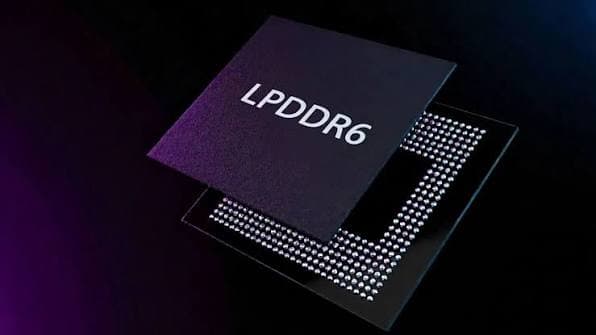
If Snapdragon 8 Elite Gen 6 Pro ships as leaked, it is the first Android platform with native LPDDR6. JEDEC standardized the interface as JESD209-6 in mid-2025. Peak pin rates run up to about 14.4 Gbps versus roughly 10.67 Gbps on LPDDR5X — on the order of a 35 percent bandwidth lift at the high end. Samsung has already demoed working LPDDR6 silicon and claimed meaningfully better power efficiency than the previous generation. For phones, that bandwidth matters most where the Adreno GPU, NPU, and ISP fight for the same memory pipe: ray-traced games, on-device agents, multi-camera computational photography.
Important nuance for buyers: OEMs can still pair Snapdragon 8 Elite Gen 6 Pro with LPDDR5X. The controller is backwards-compatible. Two phones can both say 'Gen 6 Pro' on the box and not deliver the same memory bandwidth. Check the RAM generation on the spec sheet, not just the SoC name. The standard Snapdragon 8 Elite Gen 6 (SM8950) is expected to stay LPDDR5X-only — one of the cleaner Pro differentiators this cycle.
Snapdragon 8 Elite Gen 6 Pro vs Gen 6: the sharper flagship split
Qualcomm is carving the elite tier harder than last year. Same Oryon 2+3+3 CPU shape on both chips. Different ceilings everywhere else. Snapdragon 8 Elite Gen 6 Pro (SM8975) gets Adreno 850, 18 MB GMEM, Matrix ALUs, AI Frame Fusion, optional LPDDR6, a fuller X105 modem config, and more last-level cache. Standard Snapdragon 8 Elite Gen 6 (SM8950) is tipped for Adreno 845 with 12 MB GMEM, no Matrix ALU / Frame Fusion path, LPDDR5X only, and a reduced modem config — the performance-efficiency blend for the broader flagship tier.
Read that as product strategy. Ultra-premium SKUs — Xiaomi's top trim, OnePlus's densest cooling chassis, Samsung's Snapdragon regions, maybe a gaming phone or two — will chase Gen 6 Pro. Everything else in the flagship aisle may land on standard Gen 6 and still look fast on a slide. The naming will confuse people. Teardowns and sustained benchmarks will not.
Snapdragon 8 Elite Gen 6 Pro vs Dimensity 9600, Apple A20, and Gen 5
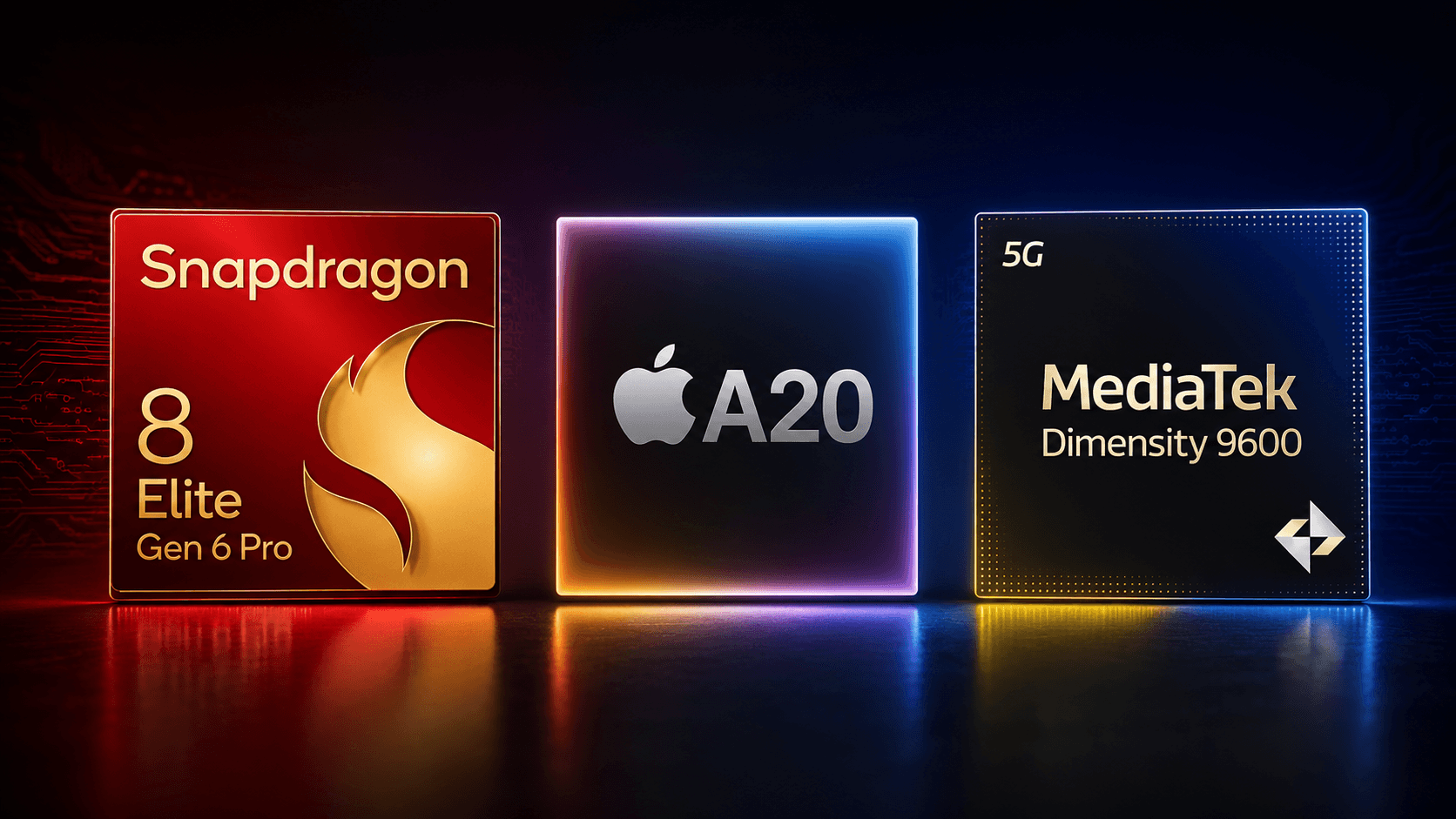
The fair comparison set for late 2026 is not last year's winners. It is the chips arriving in the same window.
Snapdragon 8 Elite Gen 6 Pro vs Gen 5 — Gen 5 powers today's Galaxy Z Fold 8 Ultra and other 2026 Android flagships. On paper Gen 6 Pro is a clear step: 2nm-class N2P versus 3nm N3P, Adreno 850 versus 840, LPDDR6 option versus LPDDR5X, Wi-Fi 8 versus Wi-Fi 7, new X105 modem. Sustained performance and thermals decide whether that is a real phone jump or a slide-deck jump. Gen 5 already set a high Oryon bar; Gen 6 Pro has to beat a strong sibling.
Snapdragon 8 Elite Gen 6 Pro vs Dimensity 9600 — the real Android rival. Both camps are tipped for TSMC 2nm-class silicon (N2P in several reports) and a similar 2+3+3 CPU shape. MediaTek is expected to lean on next-gen ARM cores and an Immortalis 'Magni' GPU with hardware frame generation. Qualcomm counters with custom Oryon, Adreno 850, and AI Frame Fusion on the Pro. Modem and global connectivity polish have historically favored Snapdragon in premium SKUs; MediaTek will try to erase that gap again. Whoever wins gaming frame-time consistency and 30-minute sustained thermals wins the enthusiast argument.
Snapdragon 8 Elite Gen 6 Pro vs Apple A20 / A20 Pro — expected on TSMC's baseline N2 for the iPhone 18 Pro generation. Several reports say Apple locked early N2 capacity, pushing Qualcomm and MediaTek onto enhanced N2P (a small performance-per-watt edge over vanilla N2 on paper). Android also looks positioned to bring LPDDR6 to market first; Apple is widely expected to stick with LPDDR5X this iPhone cycle. None of that automatically beats Apple's efficiency floor or Neural Engine stack. It does mean the cross-platform comparison will be closer on paper than Android fans usually admit.
Vs Google Tensor G6 — already the first phone chip rumored on TSMC 2nm and headed for Pixel 11 on August 12 — the comparison is almost unfair. Tensor optimizes for Gemini and camera pipelines inside Google's software; its leaked PowerVR GPU looks sideways or back for gaming. Gen 6 Pro is built to win peak Android charts. Pixel buyers should compare Tensor to Tensor.
Vs Samsung Exynos 2600 — already splitting Galaxy Z Flip 8 by region — the story is regional politics as much as benchmarks. Gen 6 Pro raises the ceiling for Snapdragon Galaxy SKUs that get it, likely starting with the S27 cycle rather than mid-cycle foldable refreshes.
Snapdragon 8 Elite Gen 6 Pro release date and first phones

Snapdragon Summit is confirmed for Maui, September 22–24, 2026 — that is the Snapdragon 8 Elite Gen 6 Pro release date for the chip announcement. Xiaomi keeps showing up as first to market, with the Xiaomi 18 series potentially sharing a China-stage moment near the keynote. OnePlus, iQOO, and other BBK brands usually follow fast. Samsung tends to wait for the next Galaxy S cycle. Commercial phone volume stretches into early 2027.
Three things matter more than the Summit demo reel. One: which phones actually solder LPDDR6, versus Gen 6 Pro chips running LPDDR5X. Two: whether AI Frame Fusion shows up as a developer-facing feature with measurable frame-time gains, or as a keynote bullet. Three: sustained Snapdragon 8 Elite Gen 6 Pro vs Dimensity 9600 performance in the same chassis class — vapor chamber size will decide as many reviews as the die will.
Should you wait for Snapdragon 8 Elite Gen 6 Pro?
Snapdragon 8 Elite Gen 6 Pro is no longer a mystery chip. It is a segmented flagship platform: 2nm-class Oryon, a fatter Adreno 850 with AI Frame Fusion, Wi-Fi 8, and Android's first real LPDDR6 on-ramp — reserved for phones that can cool it. Standard Gen 6 will do the volume work. Dimensity 9600 will contest the charts. Apple will still win the 'feels smooth for twelve hours' argument until Android OEMs prove otherwise in identical tests.
Buying a phone this month? Gen 6 Pro is irrelevant — buy the device in your hand. Planning a late-2026 or early-2027 flagship? Checklist: Pro or standard Gen 6, LPDDR6 or LPDDR5X, and how the phone dumps heat after twenty minutes of a real game. Summit confirms the slide. The phones confirm whether it mattered.
Frequently asked questions
What is the Snapdragon 8 Elite Gen 6 Pro?
Snapdragon 8 Elite Gen 6 Pro is Qualcomm's rumored next ultra-flagship mobile platform (internal name SM8975). Leaks point to a TSMC N2P 2nm-class chip with a 2+3+3 Oryon CPU, Adreno 850 GPU, optional LPDDR6 memory, AI Frame Fusion, UFS 5.0, Wi-Fi 8, and a full X105 modem. Official unveil is expected at Snapdragon Summit in Maui, September 22–24, 2026.
What are the Snapdragon 8 Elite Gen 6 Pro specs?
Reported specs (unconfirmed until Summit): TSMC N2P 2nm-class process; ~134 mm² die; 2+3+3 Oryon CPU; Adreno 850 with 18 MB GMEM and Matrix ALUs; AI Frame Fusion; 16 MB shared L2 + 8 MB LLC; LPDDR6 or LPDDR5X; UFS 5.0; X105 modem; FastConnect 8800 Wi-Fi 8; Bluetooth up to 7.0 / UWB depending on companion chip. Clock speeds are not finalized.
When is the Snapdragon 8 Elite Gen 6 Pro release date?
Chip announcement: Snapdragon Summit, September 22–24, 2026 in Maui. First phones — Xiaomi is the most commonly tipped debut partner — are expected from late 2026 into early 2027. Treat ship dates as provisional until OEMs lock pre-orders.
Does Snapdragon 8 Elite Gen 6 Pro support LPDDR6?
Yes, according to pre-Summit reporting — and it would be Android's first native LPDDR6 platform. OEMs can also pair the chip with LPDDR5X. Standard Snapdragon 8 Elite Gen 6 is expected to support LPDDR5X only.
Snapdragon 8 Elite Gen 6 Pro vs Gen 6: what's the difference?
Both are expected to share the same 2+3+3 Oryon CPU layout. Gen 6 Pro steps up to Adreno 850 (vs Adreno 845), more graphics memory, Matrix ALUs with AI Frame Fusion, optional LPDDR6, a fuller X105 modem config, and more last-level cache. Regular Gen 6 is the broader flagship part.
Snapdragon 8 Elite Gen 6 Pro vs Dimensity 9600 — which is better?
Too early for benchmarks. Both are tipped for TSMC 2nm-class silicon and similar CPU shapes. The fight will likely be decided on GPU frame-time (Adreno 850 + AI Frame Fusion vs Immortalis Magni hardware frame gen), sustained thermals, and modem/connectivity. Wait for side-by-side phone reviews.
How does Snapdragon 8 Elite Gen 6 Pro compare to Apple A20?
Apple's A20/A20 Pro is expected on baseline TSMC N2 with LPDDR5X for iPhone 18 Pro. Qualcomm's Gen 6 Pro is tipped for enhanced N2P with optional LPDDR6. That looks competitive on paper, but Apple's efficiency and software stack still set the real-world bar until identical-protocol reviews exist.
Is Snapdragon 8 Elite Gen 6 Pro better than Gen 5?
On paper, yes — newer process node, Adreno 850 vs 840, LPDDR6 option, Wi-Fi 8, and a new modem generation. Gen 5 is already strong in 2026 phones like the Galaxy Z Fold 8 series. Whether Gen 6 Pro feels like a must-upgrade depends on sustained performance and phone cooling, not Summit slides alone.
Which phones will use Snapdragon 8 Elite Gen 6 Pro first?
Xiaomi 18 series is the most commonly tipped debut. OnePlus, iQOO, and other premium Android brands usually follow quickly. Samsung is more likely to wait for a Galaxy S cycle. Expect late 2026 announces and early 2027 volume.