Valve Steam Machine: $1,049 price, specs, benchmarks, and PS5 comparison
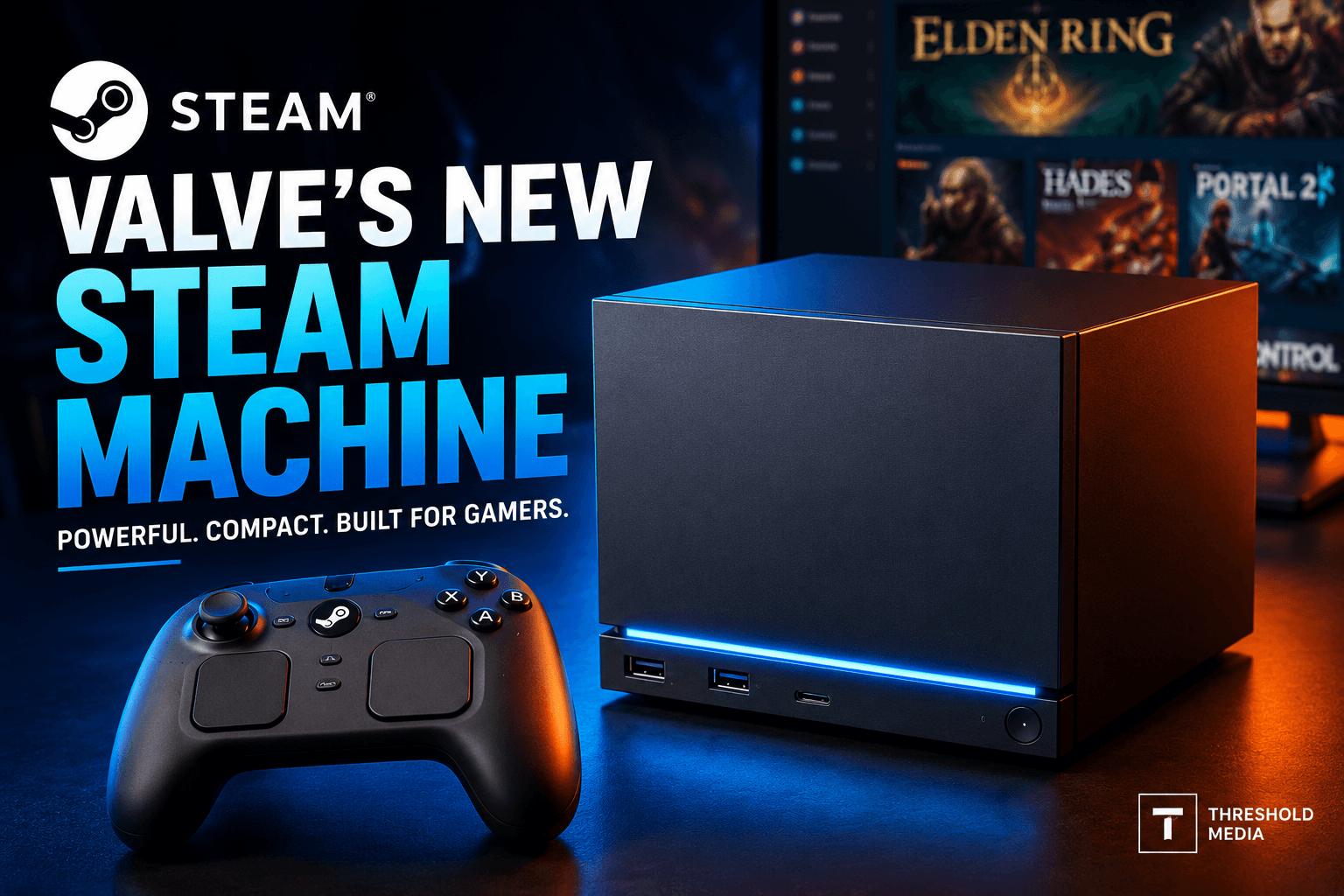
/ Valve's $1,049 living-room PC runs SteamOS on custom AMD silicon — here is the full spec sheet, gaming benchmark breakdown, PS5 comparison, and who should actually buy one.
by Hozefa Khety
· 9 min read
Valve's Steam Machine arrives in June 2026 as the company's most ambitious attempt yet to put PC gaming on the living-room TV — a matte black cube running SteamOS, navigable entirely from a controller, and priced well above what most console buyers expect to pay. Reservations opened at $1,049 for the 512GB model and $1,350 for 2TB in the US, with UK pricing at £879 and £1,149 respectively. Shipping begins June 29. That puts the Machine at roughly 75% more than a base PlayStation 5 while delivering, in raw gaming terms, performance in the same ballpark as Sony's six-year-old hardware. The pitch is not horsepower alone. It is openness: your full Steam library, no online subscription fee, desktop Linux when you need it, and a form factor small and quiet enough to sit under the TV without apology.
This is Valve's second run at the Steam Machine concept after the ill-fated 2014 lineup. The 2026 model pairs semi-custom AMD silicon with a decade of SteamOS development — Proton for Windows games, suspend-and-resume, HDMI-CEC integration, and magnetic faceplates with an RGB download-progress strip. Whether the package justifies a four-figure price tag depends on how much you weight software polish against silicon, and on how carefully you read Valve's marketing around 4K gaming.
Steam Machine specs and pricing
Valve built the Steam Machine around laptop-class AMD parts with strict power limits. The CPU is a 6-core, 12-thread Zen 4 chip rated for up to 4.8 GHz boost but capped at 30W TDP. The GPU uses RDNA 3 architecture with 28 compute units, a 2.45 GHz sustained clock, 110W TDP, and 8GB of GDDR6 VRAM — closer to a mobile RX 7600M than a desktop graphics card. System memory is 16GB of DDR5-5600, supplied as either a single 16GB module or 2×8GB depending on component availability. A 300W internal power supply feeds the lot. Storage comes in 512GB or 2TB NVMe SKUs, both user-replaceable.
Connectivity includes four USB Type-A ports (the rear pair are USB 2.0; the front pair and USB-C are 3.2), microSD, HDMI, DisplayPort, and gigabit Ethernet. There is no dedicated 3.5mm audio jack — output routes through HDMI, DisplayPort, or USB. Valve added separate internal antennas for Wi-Fi, Bluetooth, and Steam Controller wireless. Optional bundles pair the box with Valve's new $79 Steam Controller for $1,128 (512GB) or $1,429 (2TB); UK bundle pricing runs £938 and £1,208.
Valve has been explicit that it is not subsidizing the hardware with Steam store margins the way console manufacturers subsidize their boxes. The company pointed to soaring RAM and storage costs — the same supply squeeze that pushed Steam Deck prices up 40% earlier in 2026 — as the reason launch pricing landed higher than internal targets. Valve sells the Machine at component cost and has partnered with iFixit for repair guides and replacement parts, including the custom internal PSU.
SteamOS and the living-room experience
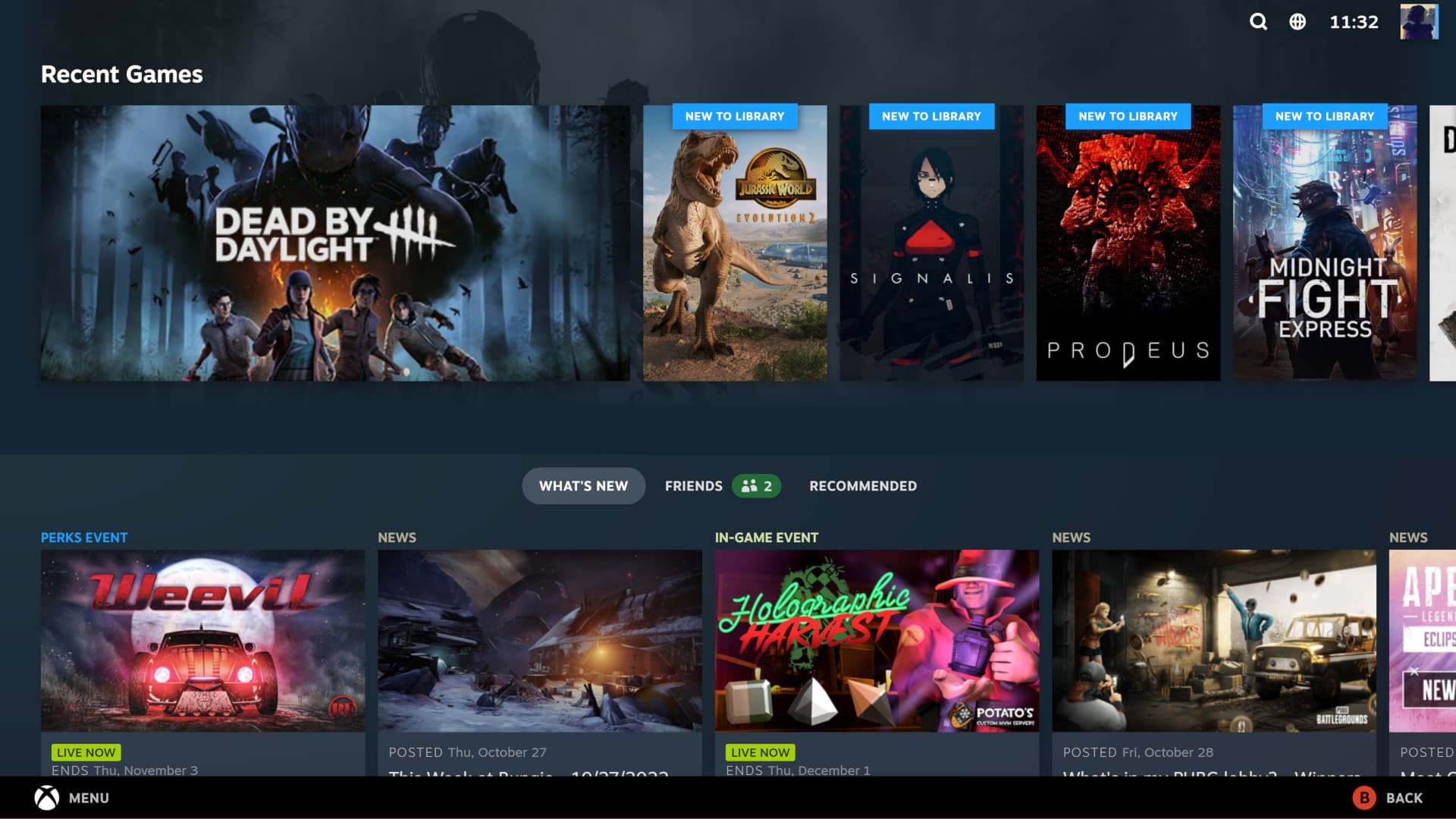
Steam Deck owners will recognize the interface immediately. SteamOS handles downloads, friends, settings, and game launches from Big Picture mode without touching a keyboard. Windows titles run through Proton, Valve's compatibility layer, which removes the traditional Linux gaming friction of driver hunting and command-line fixes. Suspend-and-resume works from the controller: put the system to sleep mid-game and pick up within seconds, much like a console. Desktop mode is a full Linux environment — plug in a keyboard, mouse, and monitors and the Machine behaves like a compact workstation, useful for browsing, productivity, or installing software outside Steam.
HDMI-CEC is the sleeper feature. Most PCs ignore the protocol that lets HDMI devices coordinate power and input switching. Valve wrote custom firmware so waking the Steam Machine with a paired controller can power on the TV, soundbar, and receiver and select the correct input automatically. Bluetooth gamepads from third-party manufacturers can trigger the same wake sequence. TV volume is adjustable from the Quick Access Menu, and some TVs can navigate Steam menus over HDMI — though gameplay still requires a proper controller.
Launch software still has rough edges. First-boot setup can require downloading Proton and other dependencies before games run. Suspend behavior is inconsistent on pre-release units — some sessions resume hours later intact, others do not. Valve ships games capped at 1080p by default even when connected to a 4K display, which means owners must manually raise per-game resolution limits to use upscaling or native higher resolutions. That default sits awkwardly beside marketing that references 4K at 60 frames per second. Controller disconnects, UI stutter while a game is suspended, and missing per-title graphics presets are day-one issues Valve will likely patch — the Steam Deck followed a similar trajectory from rough launch to polished product within a year.
Performance benchmarks: good enough, not 4K native
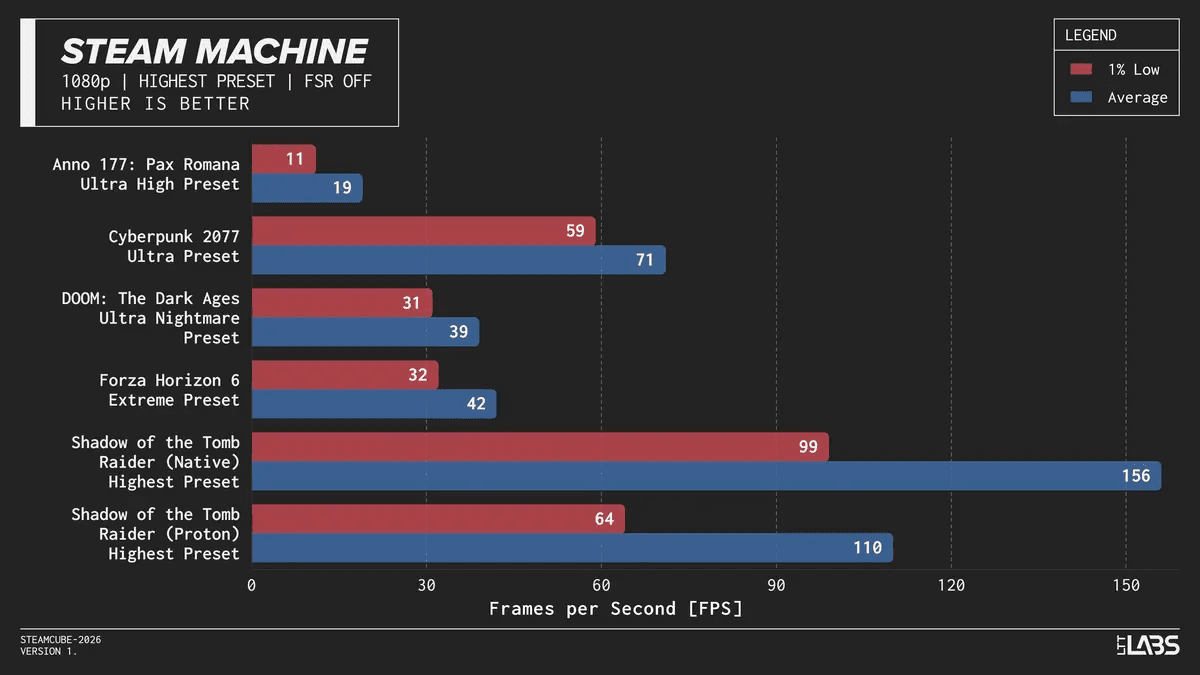
Valve says the Steam Machine should outperform roughly 70% of gaming PCs currently in use. Measured against discrete desktop hardware, GPU performance lands near an RTX 3060, RX 6600, or Intel Arc A750 depending on the title — generally 15–20% behind an unrestricted RX 7600 because of the Machine's tight TDP ceiling. At 1080p Ultra, Cyberpunk 2077 averages about 59 FPS, Starfield about 41 FPS, and Black Myth: Wukong roughly 44 FPS. CPU-bound tasks perform closer to a Ryzen 5 3600–5600X depending on the workload: fine for gaming, less impressive for heavy compression or rendering relative to an unconstrained desktop chip.
The benchmark charts above tell a sharper story. At 1080p with FSR disabled and highest presets, Cyberpunk 2077 hits 71 FPS average while Shadow of the Tomb Raider native reaches 156 FPS — older, well-optimized titles fly; current-generation releases do not. DOOM: The Dark Ages holds 60 FPS only on Low settings; Medium drops to 46 FPS and Ultra Nightmare to 39. Anno 117: Pax Romana manages just 19 FPS on Ultra High. Forza Horizon 6 is the standout at 66 FPS on High, though Extreme preset falls to 42 FPS. Valve's 4K/60 marketing only holds when FSR Ultra Performance is enabled at lowest presets — upscaling from roughly 720p base resolution — where all five charted titles clear 60 FPS average at the cost of visible image quality.
Ray tracing is effectively off the table. Cyberpunk with ray tracing at medium settings averages around 15–23 FPS at 1080p depending on driver version. Games that require RT hardware, including Doom: The Dark Ages and Indiana Jones and the Great Circle, struggle to maintain 60 FPS except at reduced settings. The practical path to smooth couch gaming is 1080p or 1440p with FSR upscaling to a 4K TV — Indiana Jones, Returnal, and Forza Horizon 6 can hold above a 40 FPS floor at 1440p medium on a VRR display, which feels acceptable at typical living-room distances. PlayStation ships per-title optimized presets; the Steam Machine has no equivalent profiles yet, though Valve has confirmed FSR 4 support is on the way.
Steam Machine vs PS5: the value gap
On paper the Steam Machine offers more CPU headroom, double the system RAM, and an open game library. In practice, a $600 PS5 — controller included — often delivers equal or better image quality per dollar in cross-platform titles. In God of War Ragnarok, a PS5 upscaling from 1440p to 4K holds 75–78 FPS in comparable scenes while the Steam Machine manages 60–63 FPS with medium settings and FSR Quality. Drop the Machine to native 1440p and it breaks 70 FPS, suggesting FSR overhead costs more frames than expected. Cyberpunk 2077 and Horizon Zero Dawn Remastered also look sharper on Sony's box at default configurations.
Price is where the comparison breaks down hardest. The Steam Machine starts at $1,049 without a controller against a PS5 at $600 or a PS5 Pro at $900 — both including a DualSense. A DIY desktop with similar paper specs can be assembled for under $1,000 in parts and will outperform the Machine in gaming because desktop CPUs and GPUs are not power-limited to 30W and 110W. Valve's 512GB SKU undercuts some prebuilt OEM systems with an RX 7600 by a few hundred dollars, but those boxes run their GPUs at full TDP. The fair comparison for the Steam Machine is not peak frames — it is the total package: form factor, acoustics, SteamOS integration, and repairability.
Long-term costs tilt back toward PC. Steam multiplayer is free — PlayStation Plus runs $110 per year for online play. Steam's sale cadence and third-party store support through desktop mode (Epic, GOG, emulators) widen software choice. Console buyers trade that flexibility for plug-and-play simplicity, exclusive titles, and manufacturer-tuned graphics presets. At $1,049, Valve is selling an ecosystem philosophy as much as a frame rate.
Thermals, noise, and repairability
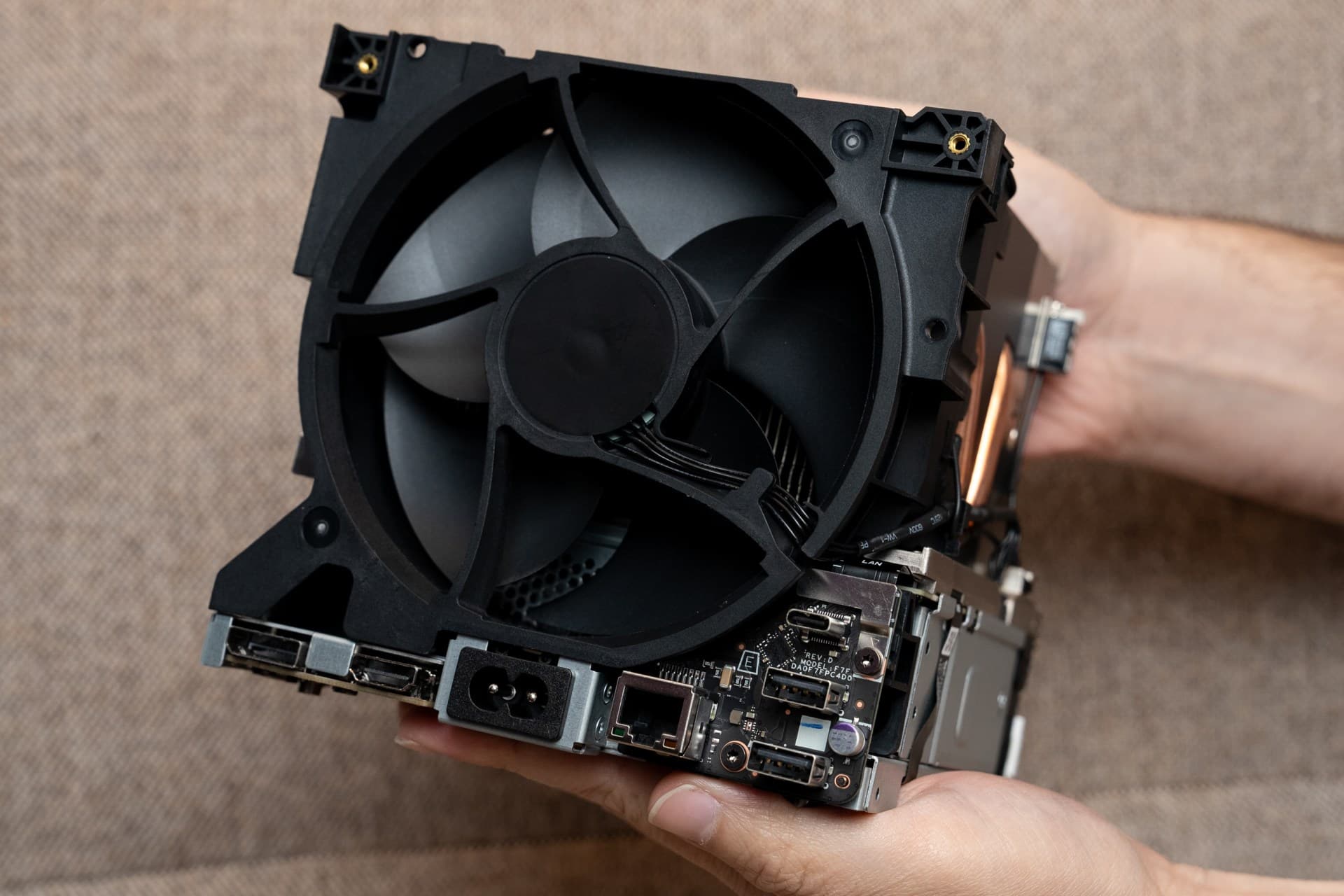
Industrial design is where the Machine earns its premium over DIY alternatives. Idle noise is effectively inaudible; under sustained gaming load the system holds around 23–24 dBA — comparable to a PS5 and well below typical gaming desktops in the 30–35 dBA range. Power draw during gaming averages 175–176W from the wall, with brief torture-test spikes near 209W before CPU throttling settles around 192W, comfortably inside the 300W PSU headroom. CPU and GPU temperatures under load average roughly 68°C and 66°C respectively. Valve's solid front panel deliberately restricts intake airflow to suppress noise, trading a few degrees of thermal headroom for acoustics.
The enclosure is roughly half the volume of a PS5. A single axial fan pulls air through a tunnel past the CPU and GPU heatsinks; the integrated PSU sits in the same stack. Magnetic faceplates remove without tools — the 2TB bundle ships with alternate fuzzy red and walnut panels, and Valve plans to publish CAD files for custom 3D-printed designs. RAM and the M.2 SSD are accessible after removing the base panel; the 2TB configuration ships with a Kingston 2048GB NVMe drive. CPU and GPU are soldered and not user-replaceable. Wired Ethernet delivers near-gigabit download speeds from Steam's CDN; Wi-Fi 6E reaches roughly half that throughput in testing.
Who should buy the Steam Machine — and who should wait
The Steam Machine makes sense if you already live in Steam, want couch gaming without a keyboard, value HDMI-CEC and suspend-and-resume, or need a compact desktop for a dorm or small office alongside TV duty. Wait if you expect native 4K/60 in modern AAA games, want ray tracing, need console-simple setup on day one, or are shopping on a strict budget — a PS5 Pro or self-built PC delivers more performance per dollar.
Early adopters should budget time for manual graphics tuning, expect a 1080p default resolution cap, and know that some titles with kernel-level anticheat (including the F1 series) will not run on SteamOS. Valve secured only about two-thirds of its planned launch inventory amid ongoing memory shortages and uses a randomized reservation queue to limit scalping. The Steam Deck proved Valve can iterate fast on hardware through software updates; the Machine will likely follow that arc. It is not a mainstream console killer at this price — it is a polished, repairable, whisper-quiet path to PC gaming from the sofa, and for the audience that has waited for exactly that, the trade may be worth making.
Frequently asked questions
How much does the Valve Steam Machine cost?
In the US, the 512GB Steam Machine starts at $1,049 and the 2TB model at $1,350. Bundles with the Steam Controller cost $1,128 and $1,429 respectively. UK pricing is £879 for 512GB and £1,149 for 2TB.
When does the Steam Machine release?
Valve opened reservations in June 2026, with shipping scheduled to begin June 29, 2026. Availability uses a randomized reservation queue to reduce scalping.
What are the Steam Machine specs?
It uses a 6-core Zen 4 CPU (30W TDP, up to 4.8 GHz boost), a custom RDNA 3 GPU with 28 CUs and 8GB GDDR6 (110W TDP), 16GB DDR5-5600 RAM, a 300W internal PSU, and either a 512GB or 2TB NVMe SSD. RAM and storage are user-upgradeable.
Can the Steam Machine play games at 4K 60fps?
Only with significant compromises. Older or lighter titles can hit true 4K, but modern AAA games generally need FSR upscaling from 1080p or 1440p. Hitting 4K/60 on current titles requires lowest presets with FSR Ultra Performance, upscaling from roughly 720p.
How does the Steam Machine compare to a PS5?
Performance is broadly similar to a base PS5 in many titles, but the Steam Machine costs nearly twice as much and lacks console-style optimized presets. Advantages include the full Steam library, free online multiplayer, open peripheral support, desktop mode, and HDMI-CEC integration.
Can you upgrade the Steam Machine?
Yes — RAM and SSD are upgradeable, and Valve partnered with iFixit for repair guides and replacement parts including the custom power supply. The CPU and GPU are not socketed or user-replaceable.