Xiaomi Xring O3 jumps Qualcomm to LPDDR6 — and claims the first 5M AnTuTu phone chip

/ Xiaomi's second flagship SoC stays on 3nm, ditches little cores, and ships native LPDDR6 before Snapdragon Summit. Xiaomi 18 Fold and Pad 9 Pro Max get it in September.
by Hozefa Khety
· 9 min read
Xiaomi just put a stake in the ground that Qualcomm and MediaTek were supposed to own. On August 24, 2026, the company unveiled the Xring O3, its second-generation flagship phone chip, and claimed the first mobile SoC past five million AnTuTu points, the first shipping phone platform with LPDDR6, and a ten-core CPU with no little cores at all. The catch is the process node. O3 stays on TSMC's N3P 3nm while Snapdragon, Dimensity, and Apple chase 2nm. Xiaomi is betting architecture and memory beat a node skip.
The numbers below are Xiaomi's. Independent reviews do not exist yet. Treat the bench scores as marketing until September phones show up under real vapor chambers. With that caveat, here is what Xring O3 actually is, where it ships first, and why the LPDDR6 headline matters more than the AnTuTu number.
Xring O3 specs: 3nm, 24 billion transistors, all big cores
Xring O3 is built on TSMC N3P. Die size is 133 mm², up from 109 mm² on Xring O1, packing about 24 billion transistors. Xiaomi says the project took 459 days. The CPU is a ten-core, all-big-core layout: two ARM C1-Ultra cores at up to 4.35 GHz, four C1-Premium cores at 3.68 GHz, and four C1-Pro cores at 3.15 GHz. No efficiency cluster. Xiaomi also cites dual SME2 acceleration units on the CPU path. That is a deliberate break from the mixed big-little designs Qualcomm, MediaTek, and Google still ship.
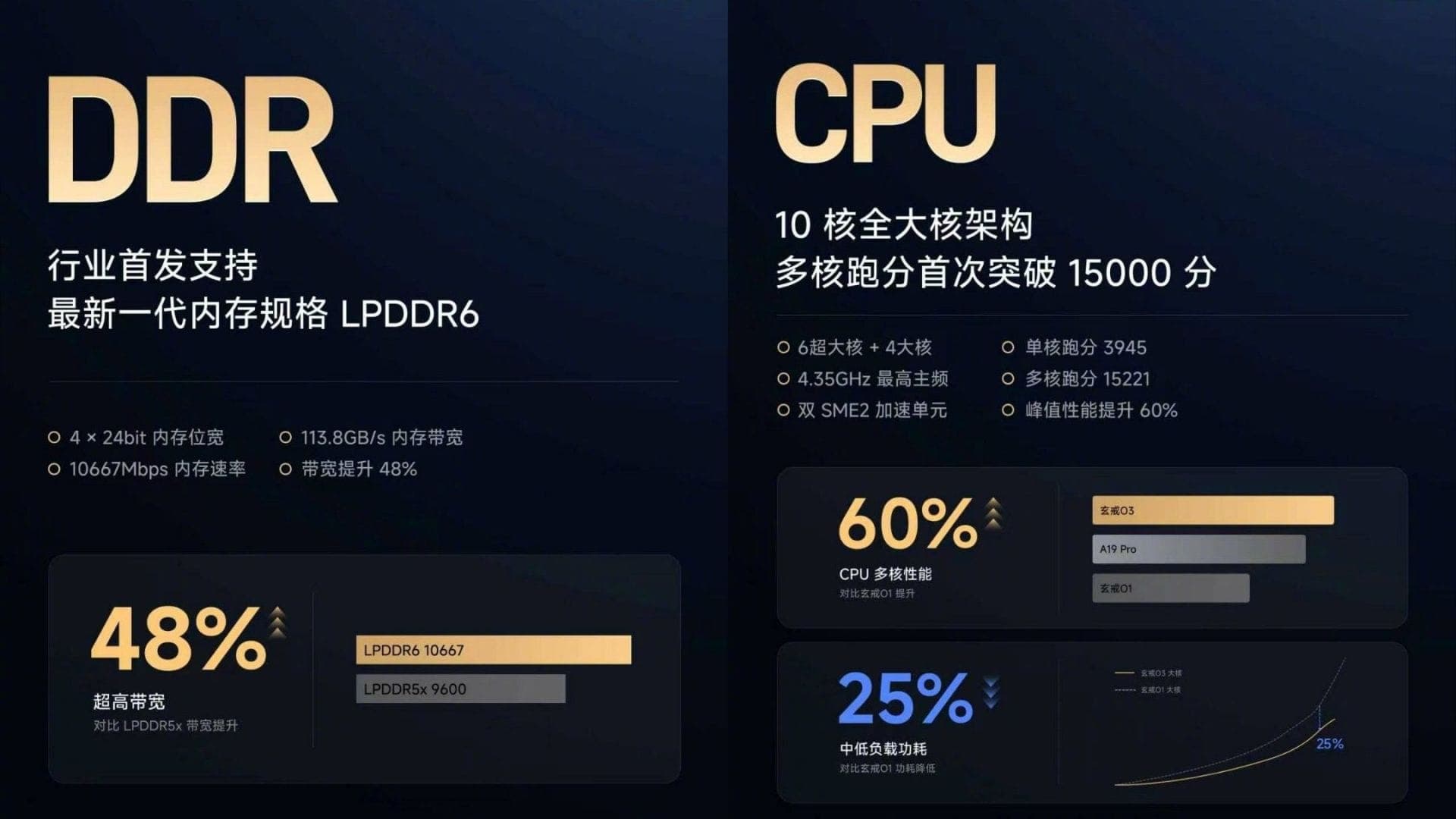
Cache grew with the die. Xiaomi cites 16 MB of system-level cache. On Geekbench 6.5, Xiaomi quotes 3,945 single-core and 15,221 multi-core, the first time its stack has cleared 15,000 multi-core on its own charts, about 31% and 61% above Xring O1 on those runs. Peak multi-core is claimed up about 60% vs O1. Power under light and medium loads is claimed down about 25%. Peak synthetic scores on an all-big design will look strong. Sustained thermals in a foldable chassis are the open question.
Graphics are a 16-core Mali G2-Ultra NX with eight NX neural-network units. Xiaomi claims roughly 85% higher overall GPU performance than O1, 182% better ray tracing, and 64% lower GPU power. Quoted scores: 4,567 on 3DMark Steel Nomad Lite and 3,628 on Solar Bay Extreme. The company also says Solar Bay Extreme beats Apple's A19 Pro by about 63%. Those bars are Xiaomi Lab results on a development board. Independent phones will decide if they stick.
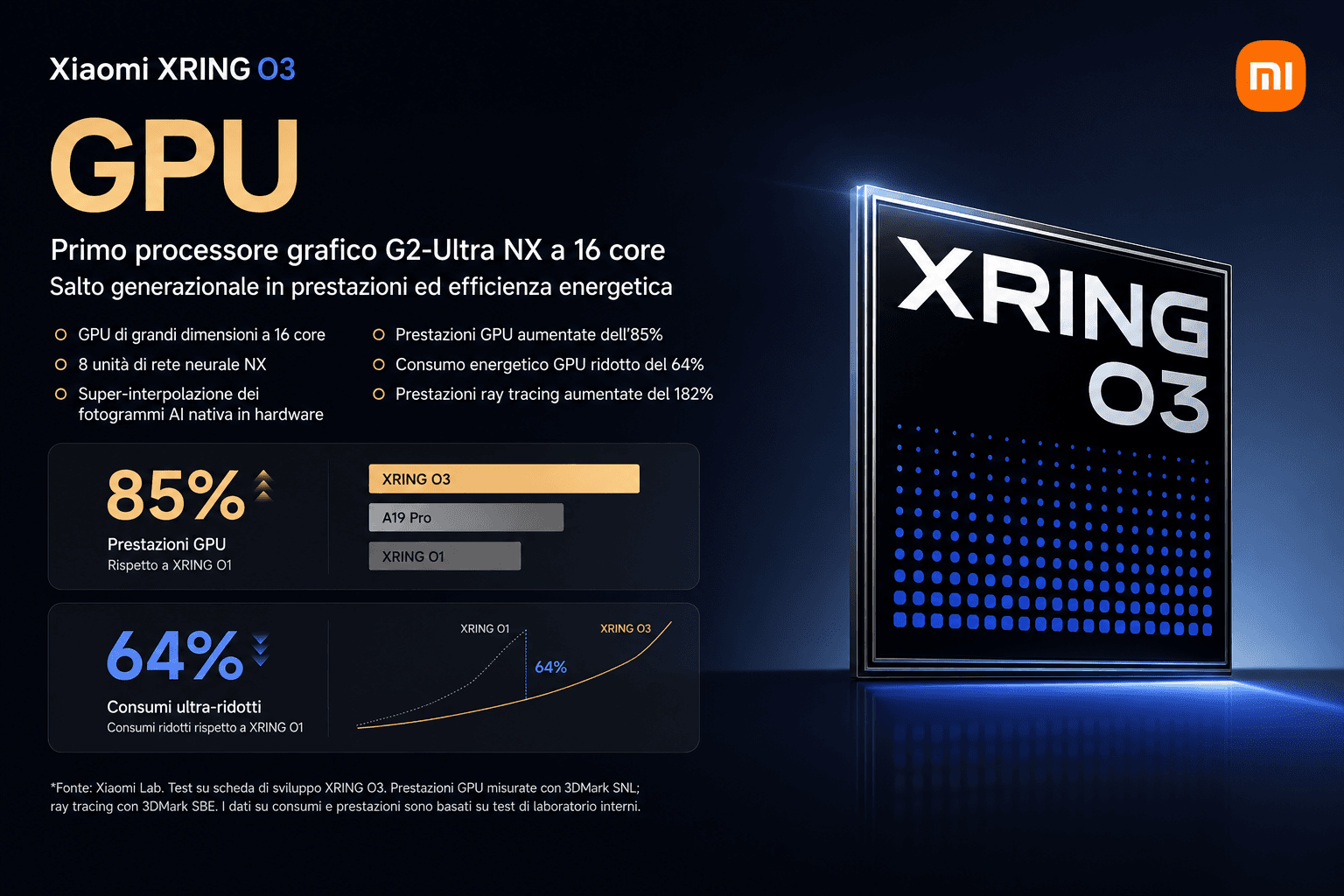
The GPU also carries native hardware AI frame interpolation. Xiaomi's demo claim is blunt. Games can render at 540p, scale to 1080p, and use about 20% less power than native 1080p. Frame generation can stretch 60 fps gameplay to 120 fps. That is the same category of feature Qualcomm is teasing as AI Frame Fusion on Snapdragon 8 Elite Gen 6 Pro. Xiaomi just put the marketing version on a slide first.
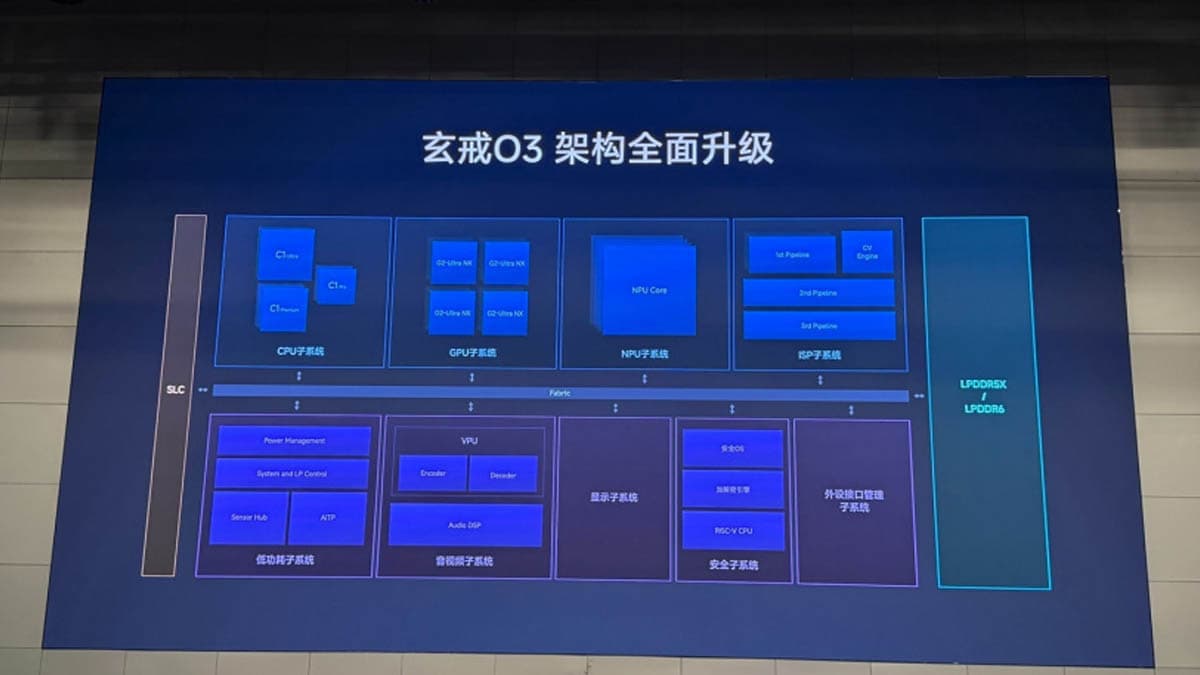
On-device AI sits on a redesigned four-core NPU rated at up to 200 TOPS tensor and 3.13 TFLOPS vector, with Xiaomi claiming a 45% NPU lift over O1. Acceleration is spread across CPU, GPU, ISP, DPU, and ADSP. Static memory access latency is quoted at 82 ns. The fifth-generation imaging pipeline supports sensors up to 432 MP at 24-bit color depth, plus H.266 hardware decode. The architecture slide also shows a RISC-V security core and a multi-pipeline ISP with a dedicated computer-vision engine.
LPDDR6 arrives on a phone chip before Snapdragon Summit
This is the part of the announcement that will age best. Xring O3 is the first smartphone SoC Xiaomi is shipping with native LPDDR6. Specs: 10,667 Mbps over a 4 × 24-bit bus for 113.8 GB/s of peak bandwidth, about 48% above Xring O1. JEDEC locked LPDDR6 as JESD209-6 in mid-2025. Samsung and SK Hynix have been ramping production through 2026. Xiaomi got a working controller into a shipping-bound product before Qualcomm's Maui Summit.
One nuance from Xiaomi's own diagram: the memory controller lists LPDDR5X and LPDDR6. Same story as Qualcomm's Gen 6 Pro leaks. Native support does not mean every SKU will solder the faster chips. Check the RAM generation on the phone's spec sheet, not just the SoC badge.
Bandwidth is where GPU, NPU, and ISP collide. Foldables with fat displays, on-device agents, and multi-camera stacks eat memory bandwidth before they eat CPU clocks. Beating Snapdragon to LPDDR6 matters more for Xiaomi's independence story than a single AnTuTu run. The AnTuTu V11 score Xiaomi posted is 5,228,014, the first claimed crossing of five million on a phone SoC. Synthetic charts move. Memory generations stick.
Xring O3 vs Snapdragon, Dimensity, and staying on 3nm
Xiaomi did not win the process race. Qualcomm's Snapdragon 8 Elite Gen 6 Pro and MediaTek's Dimensity 9600 are tipped for TSMC 2nm-class silicon later this year. Apple's A20 path is the same node fight for iPhone 18 Pro. Xring O3 stays on N3P. That is a generation behind on the fab roadmap, and Xiaomi knows it. The counter-argument is that O3 ships now with LPDDR6 and an all-big CPU while the 2nm Android chips are still Summit slides.
Vs Xring O1, the jump is real on paper: bigger die, new CPU cluster, much stronger GPU claims, LPDDR6, and a higher NPU ceiling. O1 already crossed a million devices across phones, tablets, and watches, per Xiaomi's earnings comments. O3 has to prove the second-gen silicon is a platform, not a China-only science project.
Vs Google Tensor G6, the comparison is almost unfair in both directions. Tensor is rumored on 2nm and optimized for Gemini and Pixel cameras. Its GPU story looks weak for gaming. Xring O3 is built to win charts and foldable gaming demos. Buyers will not cross-shop these chips in the same phone.
The fair fight lands in late 2026 and early 2027, when Snapdragon Gen 6 / Gen 6 Pro phones and Dimensity 9600 devices hit the same review benches. Xiaomi needs Xring O3 to hold multi-core and GPU frame times without cooking a foldable hinge. If it does, the "stuck on 3nm" critique gets quieter. If it throttles hard, the AnTuTu number becomes a punchline.
First phones: Xiaomi 18 Fold and Pad 9 Pro Max
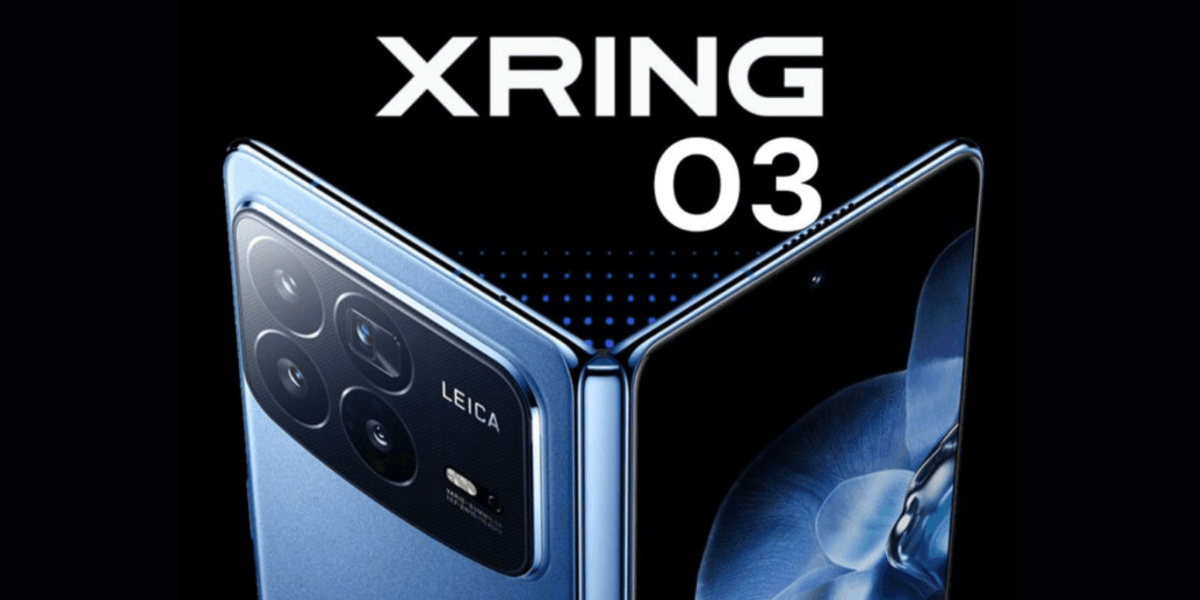
Xring O3 lands first in the Xiaomi 18 Fold and the Xiaomi Pad 9 Pro Max, both scheduled for September in China. Pre-orders for the 18 Fold are already live on Xiaomi's China channels. Tipster Ice Universe says the wide-format 18 Fold will be the first phone worldwide to ship with O3, and that the foldable will reach global markets with this chip later in 2026. That would be a change from Xring O1, which stayed China-bound.
Putting your own silicon in a foldable first is a statement. Foldables stress thermals, display bandwidth, and camera pipelines at once. If O3 holds up there, Xiaomi can argue the in-house stack is ready for the rest of the 18 series. If it does not, every Snapdragon 18 SKU becomes an admission.
Xring O100 and D100: the rest of the stack
Xiaomi did not stop at the phone SoC. Xring O100 is a 6nm near-memory AI chip aimed at Xiaomi's MiMo language model and on-device AI across phones, cars, and robots. Xiaomi quotes vertical chip-and-memory stacking with peak bandwidth around 1.22 Tbps. That is an order of magnitude above O3's LPDDR6 pipe, built for local inference rather than a phone GPU.
Xring D100 is the car play. Xiaomi calls it its first domestic 3nm intelligent-driving AI chip: 20-core CPU, 16-core NPU, up to 160 GB of unified memory, and local models up to about 200 billion parameters. Development is done. Commercial availability is planned for 2027. Read the trio together. O3 is the product you can buy this year. O100 and D100 are the vertical-integration roadmap Xiaomi keeps selling to investors.
Should you care about Xring O3 yet?
If you are buying a global Xiaomi phone tomorrow, maybe not. Volume flagships outside China still lean on Snapdragon. If you are watching who owns Android's silicon future, yes. Xiaomi just shipped a coherent second-gen story: all-big CPU, first LPDDR6 phone SoC, GPU upscaling that matches the category Qualcomm is still teasing, and a September foldable that has to prove the slides.
The honest test is simple. Does the Xiaomi 18 Fold hold frame times and battery life after twenty minutes of a real game, or does the all-big design melt into thermal limits? September answers that. Until then, Xring O3 is the loudest in-house Android chip announcement of 2026, and the first one to take LPDDR6 away from Qualcomm's Summit script.
Frequently asked questions
What is the Xiaomi Xring O3?
Xring O3 is Xiaomi's second-generation flagship smartphone SoC, announced August 24, 2026. It is built on TSMC's N3P 3nm process with about 24 billion transistors on a 133 mm² die, a ten-core all-big-core ARM CPU, a 16-core Mali G2-Ultra NX GPU, and native LPDDR6 memory support.
What are the Xiaomi Xring O3 specs?
Key Xiaomi-stated specs: TSMC N3P; 133 mm²; 24B transistors; CPU 2× C1-Ultra (4.35 GHz) + 4× C1-Premium (3.68 GHz) + 4× C1-Pro (3.15 GHz); 16 MB SLC; 16-core G2-Ultra NX GPU; four-core NPU up to 200 TOPS; LPDDR6 at up to 113.8 GB/s; H.266 decode; imaging path up to 432 MP.
Does Xring O3 support LPDDR6?
Yes. Xiaomi says Xring O3 is the first smartphone SoC with native LPDDR6, running at 10,667 Mbps on a 4× 24-bit bus for 113.8 GB/s peak bandwidth. Xiaomi's architecture diagram also lists LPDDR5X on the same controller, so individual phones may still ship the older memory.
What is the Xring O3 AnTuTu score?
Xiaomi quotes 5,228,014 on AnTuTu V11, claiming the first mobile SoC past five million points. Treat that as a vendor figure until independent reviews publish.
When do Xring O3 phones launch?
Xiaomi 18 Fold and Pad 9 Pro Max are scheduled for September 2026 in China. Tipsters say the 18 Fold will also bring Xring O3 to global markets later in 2026.
Is Xring O3 on 2nm?
No. Xring O3 uses TSMC N3P (3nm). Qualcomm and MediaTek flagship chips expected later in 2026 are tipped for 2nm-class nodes. Xiaomi is competing on architecture and LPDDR6 timing instead of the process lead.
Xring O3 vs Snapdragon 8 Elite Gen 6 Pro — which is better?
Too early. O3 is announced and headed into September devices on 3nm with LPDDR6. Gen 6 Pro is still pre-Summit, tipped for 2nm-class silicon with optional LPDDR6. Wait for side-by-side phone reviews in late 2026.
What are Xring O100 and Xring D100?
O100 is a 6nm near-memory AI chip for Xiaomi's MiMo model and on-device AI across phones, cars, and robots, with claimed bandwidth around 1.22 Tbps. D100 is a 3nm intelligent-driving chip with a 20-core CPU, 16-core NPU, up to 160 GB unified memory, and commercial plans for 2027.